




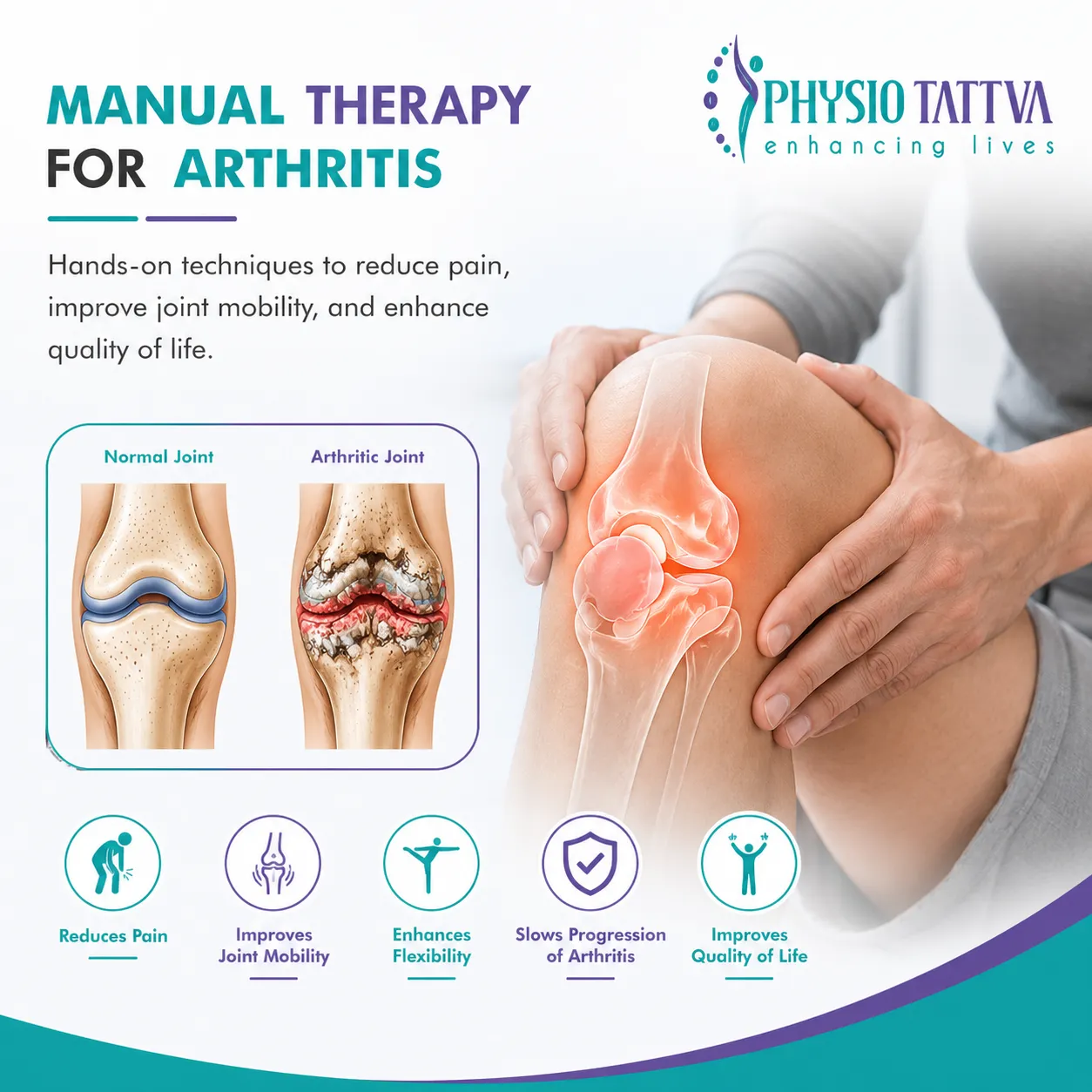
Manual therapy plays an important role in the non-pharmacological management of arthritis by helping reduce pain, improve joint mobility, and support everyday function. Delivered by trained physiotherapists, it focuses on restoring movement and easing stiffness through hands-on techniques tailored to individual needs.
This article explains what manual therapy involves, how it helps manage arthritis symptoms, the techniques commonly used, and the key safety considerations to keep in mind.
What is Manual Therapy?
Manual therapy is a clinical approach that uses skilled, hands-on techniques to diagnose and treat musculoskeletal pain and dysfunction. Performed by trained healthcare professionals like physical therapists, chiropractors, and osteopaths, it involves manipulating and mobilizing joints, muscles, and soft tissues to restore normal function.
For arthritis, the goal is not to cure the underlying disease but to manage its primary symptoms: pain, stiffness, and reduced range of motion.
How Does Manual Therapy Help Arthritis?
The hands-on application of pressure and movement provides several key benefits for arthritic joint:
- Pain Reduction: Gentle mobilization and soft tissue techniques can help modulate pain signals sent to the brain (a concept known as the "Gate Control Theory of Pain"). It also helps release natural pain-relieving endorphins.
- Improved Range of Motion: Arthritis causes joints to become stiff and "stuck." Manual therapy techniques gently move the joint through its available range, stretching the tight joint capsule and surrounding tissues to improve flexibility.
- Decreased Joint Stiffness: By promoting the circulation of synovial fluid (the joint's natural lubricant), manual therapy can significantly reduce the morning stiffness and post-activity soreness common in arthritis.
- Reduced Muscle Guarding: Painful joints often cause surrounding muscles to tighten up in a protective spasm, a phenomenon called "muscle guarding." This guarding increases pressure on the joint and creates its own source of pain. Manual therapy helps relax these muscles, breaking the pain-spasm cycle.
- Improved Function: By reducing pain and increasing mobility, manual therapy helps individuals perform daily activities, like walking, climbing stairs, dressing, and reaching, with greater ease.
Common Manual Therapy Techniques for Arthritis
A physiotherapist may use a combination of hands-on techniques based on the type of arthritis, joint involved, symptom severity, and individual functional goals.
Soft Tissue Mobilization / Therapeutic Massage
This technique focuses on treating the soft tissues surrounding an arthritic joint.
- What it is: The application of specific massage techniques (like effleurage and petrissage) to the muscles, ligaments, and fascia surrounding the affected joint.
- Purpose: To reduce muscle tension, improve blood flow, decrease swelling, and break down minor scar tissue or adhesions. This is more clinical and targeted than a relaxation massage.
Joint Mobilization
Joint mobilization is a core manual therapy technique used in arthritis care.
- What it is: A primary technique for arthritis. The therapist performs slow, passive, and graded movements of the joint surfaces. These can range from small, gentle oscillations to larger movements at the end of the available range.
- Purpose: To improve joint mobility, stimulate synovial fluid, and stretch a stiff joint capsule without causing pain or inflammation.
Myofascial Release
This approach targets restrictions within the connective tissue system.
- What it is: A technique that applies sustained, gentle pressure to the fascia, the web of connective tissue that surrounds muscles and organs.
- Purpose: To release restrictions and tightness within the fascial system that can contribute to pain and limited movement around a joint.
Muscle Energy Techniques (MET)
MET uses the patient’s own muscle activation as part of treatment.
- What it is: An active technique where the patient voluntarily contracts a specific muscle against the therapist's controlled resistance. Following the contraction, the muscle is gently stretched.
- Purpose: To lengthen shortened muscles and improve joint mobility by using the patient's own muscular effort.
Strain-Counterstrain
This is a gentle technique commonly used when pain sensitivity is high.
- What it is: A gentle, passive technique where the therapist identifies a tender point and moves the joint or body part into a position of maximum comfort, holding it for about 90 seconds.
- Purpose: To "reset" the neural feedback loop that causes muscle spasms and pain, making it highly effective for acute tenderness.
Joint Manipulation (Thrust Technique)
This technique is used selectively and with caution in arthritis care.
- What it is: A high-velocity, low-amplitude (HVLA) thrust applied to a joint, often resulting in an audible "pop" or "click."
- Caution: This technique is used very cautiously in patients with arthritis. It is generally contraindicated for joints affected by inflammatory arthritis (like Rheumatoid Arthritis) or in areas with significant joint instability or bone density loss. It may be appropriate for adjacent, non-arthritic joints that have become stiff.
Is Manual Therapy Safe for Arthritis?
Yes, manual therapy can be safe and effective for arthritis when delivered by a qualified and experienced practitioner. However, safety depends on careful assessment, the type of arthritis involved, and clear communication throughout treatment.
Type of Arthritis
The safety and approach of manual therapy vary depending on the specific arthritis diagnosis.
- Osteoarthritis (OA): Manual therapy is generally considered safe and beneficial for osteoarthritis. Because OA is a degenerative “wear-and-tear” condition, gentle joint mobilisations and soft tissue techniques can help reduce stiffness, improve movement, and relieve pain without increasing joint damage.
- Rheumatoid Arthritis (RA) and Other Inflammatory Arthritis: Extra caution is required for inflammatory arthritis. Manual therapy should never be performed during an active flare-up. Aggressive techniques and high-velocity joint manipulations are typically avoided on affected joints to prevent worsening inflammation, joint instability, or tissue damage.
Practitioner’s Expertise
The skill and experience of the therapist play a critical role in safety. A trained physiotherapist will perform a thorough assessment, consider imaging or medical history if needed, and select techniques that are appropriate for the joint, disease stage, and individual tolerance. Treatment plans are adapted as symptoms change.
Patient Communication
Open communication during therapy is essential for safe and effective care. Patients should report any sharp, increasing, or lingering pain during treatment. Manual therapy should feel controlled and therapeutic, not painful. Feedback allows the therapist to adjust pressure, technique, or positioning to avoid irritation or injury.
What to Expect in a Session
A manual therapy session is tailored to your condition and focuses on both immediate relief and long-term joint health. Here’s what you can typically expect:
- Assessment: The therapist will take a detailed history of your arthritis, symptoms, and goals. They will perform a physical examination to assess your range of motion, strength, and joint mobility.
- Treatment: You will lie on a treatment table while the therapist applies various hands-on techniques. The session is a partnership, with the therapist constantly monitoring your response.
- Integration with Exercise: Manual therapy is most effective when combined with a specific therapeutic exercise program. The "hands-on" work makes it easier for you to perform the "hands-off" exercises that create lasting change.
- Education: Your therapist will teach you how to manage your symptoms, modify activities, and perform exercises at home.
Disclaimer: This information is for educational purposes only. Always consult with a qualified healthcare professional, such as your doctor or a physical therapist, before beginning any new treatment for arthritis.
Supporting Arthritis Management with Manual Therapy at Physiotattva
Managing arthritis requires more than pain relief alone; it calls for improving how joints move and function in everyday life. Manual therapy, when delivered as part of physiotherapy care, helps address stiffness, muscle tension, and restricted movement through targeted, hands-on techniques.
While it is not a cure for arthritis, manual therapy supports long-term symptom control when combined with exercise therapy, education, and personalised treatment planning. This integrated approach allows individuals to move more comfortably, stay active, and protect joint health over time.
At Physiotattva physiotherapy clinics in Bangalore and Hyderabad, you receive personalised care tailored to your specific needs, ensuring effective results and comfort throughout your journey to recovery.
Don’t wait to start your recovery! Get in touch with Physiotattva for more details! Contact us at +91 89510 47001.
Why Physiotattva?
22+
50,000+
95%
200+
25+
4.8
Cities We Serve

Bangalore
At Physio Tattva, we are committed to bring access to quality physio care through ultra-modern clinics and high-skilled practitioners to all.
.webp)
Hyderabad
At Physio Tattva, we are committed to bring access to quality physio care through ultra-modern clinics and high-skilled practitioners to all.
.webp)
Vishakhapatnam
At Physio Tattva, we are committed to bring access to quality physio care through ultra-modern clinics and high-skilled practitioners to all.
Core Treatments
Core Conditions
Core Symptoms
Frequently Asked Questions
Is manual therapy effective for arthritis pain?

How often should I receive manual therapy for arthritis?
Is manual therapy safe for rheumatoid arthritis?
Does manual therapy replace exercise for arthritis?
How long does it take to see results from manual therapy for arthritis?






%20(1)-p-3200.jpeg)


.jpg)
.webp)
.webp)
.webp)