




Manual therapy is the cornerstone of modern, non-surgical treatment for Congenital Talipes Equinovarus (CTEV), commonly known as clubfoot. This approach focuses on gently correcting the foot's position through specific, hands-on manipulation and stretching techniques, aiming to achieve a functional, pain-free, and plantigrade (flat on the ground) foot while avoiding extensive reconstructive surgery.
The primary goal of manual therapy is to sequentially stretch the tight ligaments, joint capsules, and tendons on the inner and back of the infant’s foot and ankle.
Understanding the Clubfoot Deformity (CAVE Acronym)
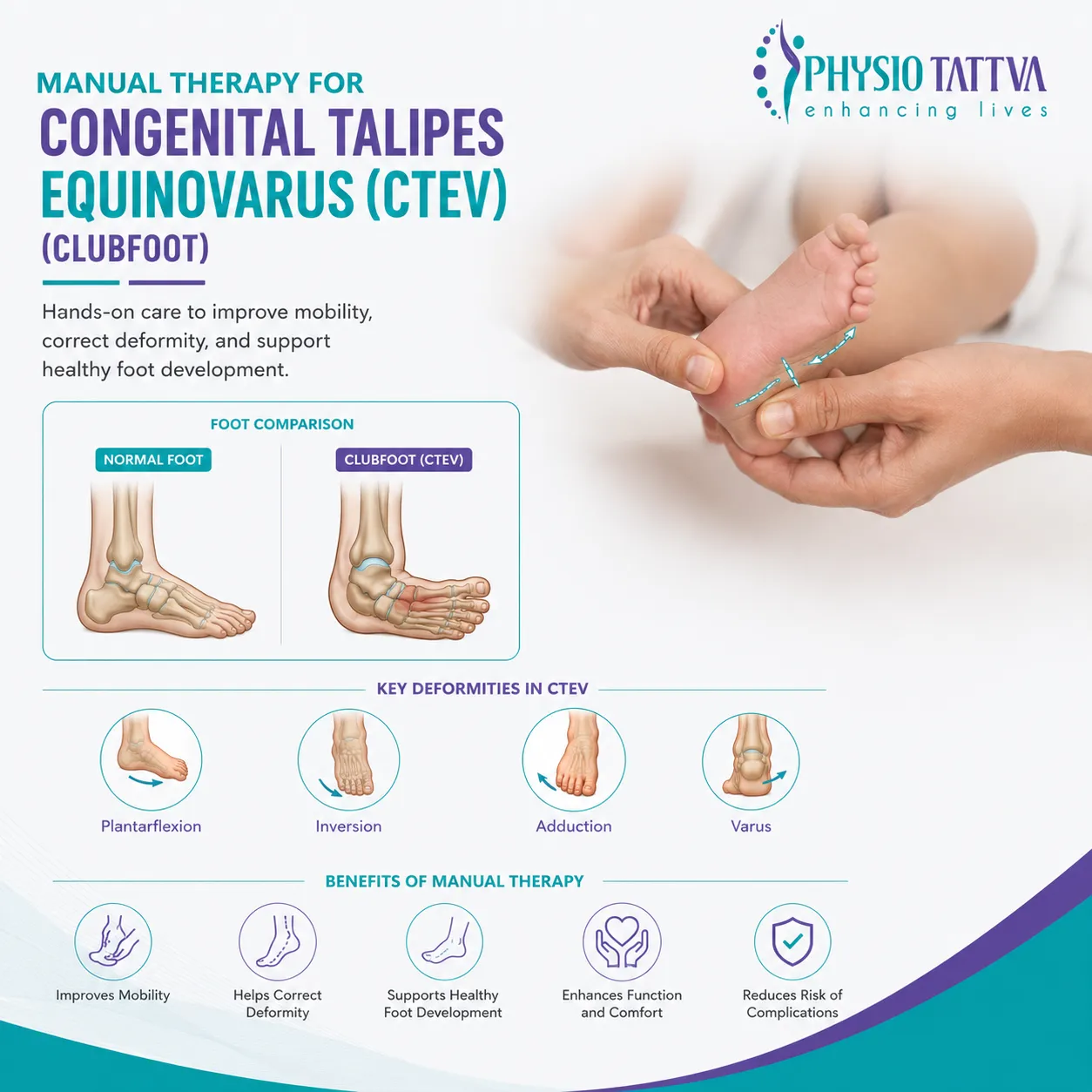
Manual therapy for Congenital Talipes Equinovarus (CTEV) is highly targeted because clubfoot is not a single deformity but a combination of four structural abnormalities. These components are commonly remembered using the CAVE acronym:
- Cavus: An abnormally high arch in the midfoot caused by muscle imbalance.
- Adductus: The forefoot turns inward toward the body’s midline.
- Varus: The heel tilts inward and upward, affecting overall foot alignment.
- Equinus: The foot points downward due to tightness in the Achilles tendon, limiting ankle movement.
Effective manual therapy follows a specific corrective sequence. The deformity is addressed in order, Cavus first, followed by Adductus and Varus, with Equinus corrected last, to ensure safe, gradual, and lasting correction while protecting the infant’s delicate joints and soft tissues.
The Ponseti Method: The Gold Standard for Clubfoot (CTEV) Treatment
The most widely practiced and successful form of manual therapy for clubfoot is the Ponseti Method. It boasts a success rate of over 95% when performed correctly. This method is a complete system involving three distinct phases.
Phase 1: Manipulation and Serial Casting
This phase forms the foundation of clubfoot correction and represents the most critical manual therapy component of the Ponseti Method. It focuses on gradually correcting the foot’s position through precise handling and sustained casting during the early weeks of life.
To ensure safe and effective correction, this phase includes the following key elements:
- Who Performs It: A pediatric orthopedist or a specially trained physical therapist or healthcare provider.
- When It Starts: Ideally within the first few weeks after birth, when the baby's ligaments and tendons are most elastic.
- The Process:
- Gentle Manipulation: In a specific, counterintuitive sequence, the provider gently manipulates the foot to stretch the tight structures. A key principle is to abduct (turn outward) the forefoot while stabilizing the head of the talus (an ankle bone) to prevent it from rotating.
- Correction Sequence: The C, A, and V (Cavus, Adductus, Varus) are corrected first over several sessions.
- Serial Casting: After each weekly manipulation session (which lasts only a few minutes), a long-leg, bent-knee cast is applied. This cast holds the correction achieved during the manipulation and allows the soft tissues to gradually lengthen.
- Repetition: This cycle of manipulation and casting is repeated weekly for an average of 5-8 weeks. With each new cast, the foot is brought closer to a corrected position.
Phase 2: Achilles Tenotomy
Once the first three components of the clubfoot deformity have been corrected, attention shifts to addressing the final remaining issue. Equinus, or the downward pointing of the foot, is typically caused by a very tight Achilles tendon that does not respond fully to stretching alone. To safely correct this, the following steps are involved:
- Purpose: The final component, Equinus (downward pointing foot), is caused by an extremely tight Achilles tendon that does not respond fully to stretching.
- The Procedure: To correct this, a simple, minimally invasive procedure called an Achilles tenotomy is performed in over 90% of cases. Under local anesthesia, the provider makes a tiny incision to release the tendon, allowing the heel to drop into a normal position.
- Post-Procedure: A final cast is applied and worn for 2-3 weeks to allow the tendon to heal in its newly lengthened position.
Phase 3: Maintenance and Bracing
This phase is critical for preventing relapse. Even after perfect correction, the foot has a strong tendency to return to its original position.
- The Device: A Foot Abduction Brace (FAB), often called "boots and bar," is used. This consists of two shoes or sandals attached to a bar that holds the feet turned outward.
- Wearing Schedule:
- Initially: Worn for 23 hours a day for the first 3 months.
- Long-Term: Worn only during naps and at nighttime until the child is 4-5 years old.
- Importance: Strict adherence to the bracing protocol is the single most important factor in preventing clubfoot relapse.
Alternative Manual Therapy: The French Functional Method
Another recognized approach is the French Functional (or Physical Therapy) Method. It relies more heavily on daily manual therapy and is more parent-intensive.
- Who Performs It: A specialised physical therapist trains the parents to perform the therapy at home.
- The Process:
- Daily Manipulation: Involves daily sessions of specific stretching, mobilization, and exercises performed by the therapist or parents multiple times a day.
- Stimulation: The therapist stimulates the muscles on the outside of the foot to encourage active correction.
- Taping and Splinting: Instead of rigid casts, the corrected position is held using non-elastic adhesive taping and custom splints, which are typically removed for each therapy session.
- Comparison to Ponseti: The French method requires a greater time commitment from the family and has a slightly higher rate of requiring supplementary surgery later. However, it can be effective for families with access to and commitment to the rigorous daily schedule.
Supporting Successful Clubfoot Correction with Physiotattva
Manual therapy is the definitive first-line treatment for clubfoot. Led by the highly successful Ponseti Method, it has revolutionized care by transforming a condition that once required extensive, debilitating surgery into one that can be managed non-surgically with excellent long-term results. The success of this approach depends on a trained provider, a precise manipulation and casting protocol, and strict family adherence to the post-correction bracing phase to ensure a lasting, functional outcome.
At Physiotattva physiotherapy clinics in Bangalore and Hyderabad, you receive personalised care tailored to your specific needs, ensuring effective results and comfort throughout your journey to recovery.
Don’t wait to start your recovery! Get in touch with Physiotattva for more details! Contact us at +91 89510 47001.
Why Physiotattva?
22+
50,000+
95%
200+
25+
4.8
Cities We Serve

Bangalore
At Physio Tattva, we are committed to bring access to quality physio care through ultra-modern clinics and high-skilled practitioners to all.
.webp)
Hyderabad
At Physio Tattva, we are committed to bring access to quality physio care through ultra-modern clinics and high-skilled practitioners to all.
.webp)
Vishakhapatnam
At Physio Tattva, we are committed to bring access to quality physio care through ultra-modern clinics and high-skilled practitioners to all.
Core Treatments
Core Conditions
Core Symptoms
Frequently Asked Questions
Is manual therapy for clubfoot painful for my baby?

How long does the entire treatment process take?
Will my child be able to walk, run, and play sports normally?
Can clubfoot come back after treatment?
Is surgery the only other option?




%20(1)-p-3200.jpeg)
.jpg)
.webp)
.webp)
.webp)