




Degenerative Disc Disease (DDD) causes pain, stiffness, and limited mobility as spinal discs lose their integrity over time. While the issue originates in the discs, much of the pain results from the body's reaction, as muscles tense up and develop painful knots, known as myofascial trigger points.
Dry needling therapy directly targets these muscular issues. While it doesn't reverse disc degeneration, it effectively reduces pain, relaxes tight muscles, and improves mobility, helping to enhance your quality of life.
What is Degenerative Disc Disease (DDD)?
Before diving into the treatment, it's important to understand the root cause. DDD isn't technically a "disease" but a natural part of aging. It involves:
- Dehydration: Spinal discs lose water and shrink.
- Loss of Height: Reduced disc height narrows the space between vertebrae.
- Tears & Cracks: The tough outer layer of the disc (annulus) can develop small tears.
This degeneration can lead to instability, inflammation, and potential nerve compression, causing symptoms like localized back/neck pain, sciatica, and radiating pain. In response, the surrounding muscles go into a state of chronic contraction and spasm.
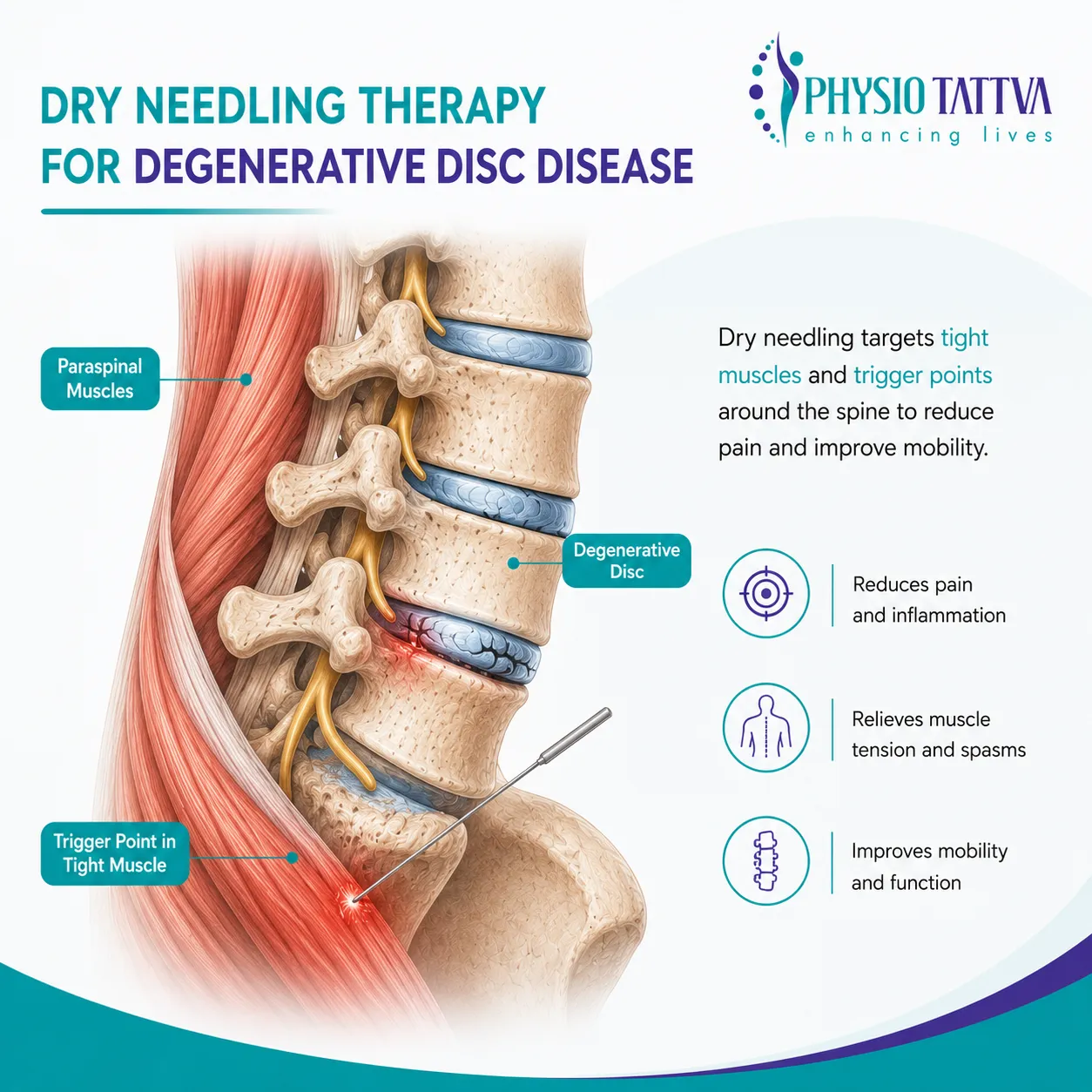
What is Dry Needling Therapy?
Dry needling is a therapeutic technique performed by trained physical therapists, chiropractors, and other healthcare professionals. It involves inserting a thin, sterile, filiform needle (the same kind used in acupuncture) into a myofascial trigger point.
A trigger point is essentially a hyperirritable "knot" within a taut band of muscle. These knots can cause localized pain, referred pain to other areas, muscle weakness, and restricted movement.
The goal of dry needling is to:
- Elicit a "Local Twitch Response": This is an involuntary spinal cord reflex where the muscle fibers contract and then relax, effectively "releasing" the knot.
- Release Muscle Tension: Deactivates the trigger point and reduces overall muscle tightness.
- Improve Blood Flow: Promotes circulation to the area, flushing out pain-causing chemicals and delivering oxygen to help the muscle heal.
- Modulate Pain Signals: Helps disrupt the pain signals being sent to the brain.
Important Distinction: Dry needling is based on Western neuroanatomy and modern scientific principles, not on Traditional Chinese Medicine (like acupuncture, which focuses on balancing "Qi" along meridians).
How Dry Needling Specifically Helps with Degenerative Disc Disease
For individuals with DDD, dry needling offers a targeted approach to pain management by addressing the muscular consequences of the condition.
Releasing Protective Muscle Spasms
When a spinal segment is unstable due to a degenerated disc, the deep spinal muscles (like the multifidus) and larger surrounding muscles (like the quadratus lumborum and glutes in the low back, or the trapezius and levator scapulae in the neck) will tighten up to "guard" the area. Dry needling directly targets and releases these spasming muscles, providing immediate relief from tightness.
Deactivating Pain-Causing Trigger Points
Chronic muscle guarding leads to the formation of active trigger points. These points are a major source of the daily, nagging pain associated with DDD. By deactivating these trigger points, dry needling can dramatically reduce both local and referred pain patterns (e.g., gluteal trigger points referring pain down the leg, mimicking sciatica).
Improving Range of Motion and Flexibility
Stiff, tight muscles severely limit your ability to bend, twist, and move comfortably. By releasing the muscular "brakes," dry needling helps restore normal movement, making it easier to perform daily activities and engage in therapeutic exercises.
Restoring Proper Muscle Function
When some muscles are chronically tight, others become weak and inhibited. This imbalance worsens biomechanics and puts more stress on the degenerated discs. Dry needling helps "reset" the tight muscles, allowing a physical therapist to then prescribe exercises to strengthen the weak ones and restore proper stabilization patterns.
Common Muscle Groups Targeted for DDD
When dealing with Degenerative Disc Disease (DDD), certain muscle groups become key contributors to pain, stiffness, and reduced mobility. These muscles often tighten up as a protective response, leading to discomfort. Below are the muscle groups commonly targeted during treatment for lumbar and cervical DDD:
For Lumbar DDD (Low Back Pain)
The muscles in your lower back play a crucial role in supporting your spine, and when DDD is present, they often become tight and painful. Targeting these muscles can help relieve pressure and improve mobility:
- Quadratus Lumborum (QL): A deep muscle connecting the ribs, spine, and pelvis; a major source of low back pain.
- Erector Spinae/Paraspinals: Muscles running along the spine, often tight and overworked in DDD patients.
- Gluteus Medius/Minimus: Key hip stabilizers; trigger points here often refer pain to the low back and down the leg.
- Multifidus: Deep spinal stabilizers that are often inhibited in people with DDD.
- Hip Flexors (Psoas): Tightness in these muscles can pull the lumbar spine forward, increasing stress on the discs.
For Cervical DDD (Neck Pain)
In cervical DDD, muscles around the neck often become tense, leading to stiffness and pain. Dry needling and other therapies target these muscles to improve range of motion and reduce discomfort:
- Upper Trapezius: The large muscle from the neck to the shoulder, commonly tight in individuals with neck pain.
- Levator Scapulae: A muscle that runs from the neck to the shoulder blade; a common cause of a "stiff neck."
- Suboccipital Muscles: A group of small muscles at the base of the skull, often responsible for tension headaches and neck stiffness.
- Scalenes: Muscles in the side of the neck that can refer pain down the arm, often associated with nerve irritation.
What to Expect from Dry Needling for Degenerative Disc Disease
When you undergo dry needling for Degenerative Disc Disease, it’s important to understand what will happen during and after your session. Dry needling is a precise technique aimed at addressing trigger points and muscle tension caused by DDD. Here’s what you can expect:
- The Session: Your practitioner will identify the trigger points by palpation. The needle insertion is often painless or feels like a small prick. When the needle hits the trigger point, you may feel a deep ache or the characteristic local twitch response, which can feel like a quick muscle cramp or jolt. This twitch is the desired therapeutic effect.
- After the Session: It is common to feel muscle soreness, similar to what you'd feel after an intense workout. This can last for 24-48 hours. Bruising is also possible. Many people, however, report an immediate improvement in range of motion and a decrease in their primary pain.
- As Part of a Plan: Dry needling is most effective when integrated into a comprehensive rehabilitation plan that includes stretching, strengthening exercises, and postural education to address the root causes of the muscle dysfunction.
Is Dry Needling the Right Treatment for Your Degenerative Disc Disease?
If you are considering dry needling for Degenerative Disc Disease (DDD), it’s important to understand who can benefit the most from this therapy. Here’s who may be a good candidate:
Who Can Benefit from Dry Needling for Degenerative Disc Disease?
You may be a good candidate for dry needling for Degenerative Disc Disease (DDD) if:
- Your pain from DDD is primarily muscular, including symptoms like tightness, spasms, or painful muscle knots.
- You have a limited range of motion due to muscle stiffness that is contributing to your discomfort.
- You experience referred pain that aligns with specific trigger points in the muscles.
- You are seeking an effective non-pharmacological pain management strategy, avoiding reliance on medications.
When Dry Needling May Not Be Suitable for Certain Individuals
Before starting dry needling therapy, it's important to consult with your doctor or physical therapist, as this treatment may not be suitable for certain individuals:
- Those with a significant fear of needles, as dry needling requires the insertion of needles into trigger points.
- Individuals on high doses of blood thinners, as dry needling could increase the risk of bleeding or bruising.
- Patients with active infections or compromised immune systems, as dry needling could exacerbate these conditions.
- Women in their first trimester of pregnancy, as certain treatments may need to be avoided during this stage.
Dry needling can offer significant relief from Degenerative Disc Disease symptoms, especially for those dealing with muscular pain and stiffness. However, it’s essential to ensure that this therapy is appropriate for your specific condition and health status by consulting with a healthcare professional.
Experience Pain Relief and Improved Mobility at Physiotattva
For those suffering from the chronic pain of Degenerative Disc Disease, dry needling therapy offers a highly effective and targeted solution for the muscular symptoms that often cause the most distress. By releasing painful trigger points and muscle spasms, it can significantly reduce pain, improve mobility, and function as a critical component in a holistic treatment plan. If you have DDD, talk to a qualified physical therapist or healthcare provider to see if dry needling can help you get back to a more active, pain-free life.
At Physiotattva physiotherapy clinics in Bangalore and Hyderabad, you receive personalised care tailored to your specific needs, ensuring effective results and comfort throughout your journey to recovery.
Don’t wait to start your recovery! Get in touch with Physiotattva for more details! Contact us at +91 89510 47001.
Why Physiotattva?
22+
50,000+
95%
200+
25+
4.8
Cities We Serve

Bangalore
At Physio Tattva, we are committed to bring access to quality physio care through ultra-modern clinics and high-skilled practitioners to all.
.webp)
Hyderabad
At Physio Tattva, we are committed to bring access to quality physio care through ultra-modern clinics and high-skilled practitioners to all.
.webp)
Vishakhapatnam
At Physio Tattva, we are committed to bring access to quality physio care through ultra-modern clinics and high-skilled practitioners to all.
Core Treatments
Core Conditions
Core Symptoms
Frequently Asked Questions
Is dry needling painful?

How many dry needling sessions will I need for my DDD?
Is dry needling safe for someone with a disc problem?






%20(1)-p-3200.jpeg)


.jpg)
.webp)
.webp)
.webp)