





Do you feel like the room is spinning or that you’re suddenly unsteady and nauseous? These symptoms are often linked to vertigo, a condition that can disrupt daily life. While vertigo is commonly associated with the inner ear, in some cases, the real cause lies in the neck. This is where dry needling therapy for vertigo can help.
If other treatments haven’t worked, relieving tight neck muscles may be the key to restoring your balance and helping you feel steady again.
Understanding Vertigo and Its Key Differences from Dizziness
Although the terms are often used interchangeably, vertigo and dizziness are not the same. Dizziness is a general feeling of lightheadedness or unsteadiness, while vertigo is the distinct sensation that you, or the environment around you, is moving or spinning.
Vertigo can develop from several underlying conditions, including:
- Benign Paroxysmal Positional Vertigo (BPPV): Caused by tiny calcium crystals (canaliths) loose in the inner ear.
- Meniere's Disease: An inner ear disorder related to fluid buildup and changing pressure.
- Vestibular Neuritis or Labyrinthitis: An inner ear problem usually related to a viral infection.
- Cervicogenic Dizziness: Dizziness and unsteadiness that originates from the neck.
It is this last type, cervicogenic dizziness, where dry needling therapy truly shines.
Cervicogenic Dizziness: When Balance Problems Start in the Neck
Your brain relies on three systems to maintain balance: your eyes (vision), your inner ear (vestibular system), and your sense of body position (proprioception). Proprioceptive signals from the muscles and joints in your neck tell your brain where your head is in space.
When the deep muscles in your upper neck are overly tight or contain trigger points (hyper-irritable knots), they send faulty information to the brain. This "bad data" conflicts with the signals from your eyes and inner ear, creating a sensory mismatch that your brain interprets as dizziness, unsteadiness, or vertigo.
You may have cervicogenic dizziness if you experience vertigo along with:
- Neck pain, stiffness, or reduced range of motion.
- Headaches, especially at the base of the skull.
- Worsening dizziness with specific neck movements or positions.
- A history of neck injury (like whiplash) or poor posture.
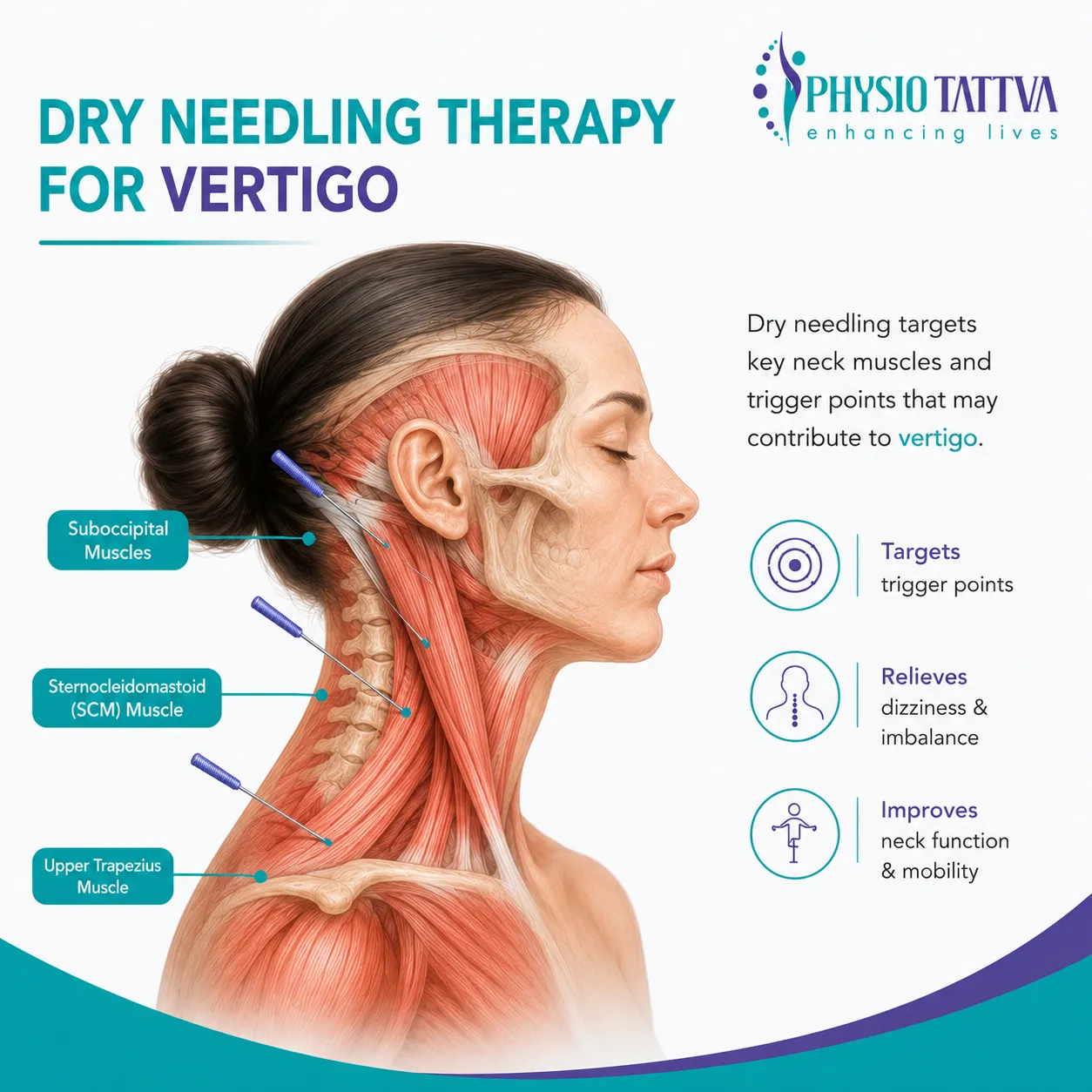
How Dry Needling Therapy for Vertigo Works
Dry needling is a skilled intervention performed by a trained physical therapist or other qualified healthcare professional. It is not acupuncture. While both use thin filiform needles, their goals are different.
- Acupuncture is based on traditional Chinese medicine and works to restore the flow of energy (Qi) along meridians.
- Dry Needling is based on modern Western medicine and targets dysfunctional muscle tissue, specifically myofascial trigger points.
Here’s how dry needling works for cervicogenic dizziness:
- Identify the Problem Muscles: A therapist will assess your neck to locate the specific muscles causing the issue. Common culprits include the suboccipitals (at the base of the skull), the sternocleidomastoid (SCM), and the upper trapezius.
- Release the Trigger Point: The therapist inserts a thin, sterile needle directly into the trigger point. This can elicit a "local twitch response"—an involuntary muscle contraction that is the first step in breaking the pain-tension cycle.
- Restore Normal Function: Releasing the trigger point helps to:
- Reduce Muscle Tension: Immediately relaxing the knotted muscle.
- Improve Blood Flow: Bringing oxygen and nutrients to the deprived tissue.
- Decrease Pain Signals: Interrupting the pain feedback loop to the brain.
- Reset Proprioception: By relaxing the muscle, it can start sending accurate signals about head position to the brain again, resolving the sensory conflict that causes vertigo.
Who Can Benefit from Dry Needling Therapy for Vertigo?
Dry needling is a powerful tool, but it's most effective when applied correctly. It's crucial to have a proper diagnosis first to rule out other causes of vertigo like BPPV or Meniere's disease.
Dry needling may be an excellent option for you if:
- Your vertigo is accompanied by neck pain, stiffness, or headaches.
- Your symptoms are triggered or worsened by holding your head in one position for too long (e.g., at a computer).
- You have a history of whiplash or other neck trauma.
- Other treatments, like repositioning maneuvers (Epley maneuver), have not worked.
A comprehensive evaluation by a physical therapist specializing in vestibular and orthopedic rehabilitation is the best way to determine the root cause of your vertigo and see if your neck is the contributing factor.
What to Expect from a Dry Needling Therapy Session
If you and your therapist decide to proceed with dry needling, here's what the process looks like:
- The Procedure: You will be in a comfortable, relaxed position. Your therapist will clean the skin and insert the needle. You may feel a small prick, but the primary sensation is often a deep ache or a muscle twitch when the trigger point is activated. This is a sign the treatment is working. The needles are typically in place for a few seconds to a few minutes.
- After the Session: It is common to feel muscle soreness, similar to what you’d feel after an intense workout. This can last for 24-48 hours. Applying heat and performing gentle stretches, as advised by your therapist, can help.
- Results: Many patients report an immediate decrease in neck stiffness and a reduction in their dizziness or vertigo, sometimes after just one session. A full treatment plan usually involves a series of sessions combined with manual therapy, stretching, and strengthening exercises to address the underlying cause of the muscle tension.
Choosing a Qualified Professional for Dry Needling Therapy
The safety and effectiveness of dry needling therapy depend greatly on the experience and training of the practitioner. It’s important to seek care from a licensed healthcare professional, such as a Physical Therapist (PT), who has advanced certification in dry needling, particularly when treating sensitive areas like the neck.
Before starting treatment, consider asking potential providers the following questions:
- Are you formally certified in dry needling therapy?
- Do you have experience treating cervicogenic dizziness and vertigo using dry needling?
Choosing a skilled and knowledgeable practitioner ensures safer treatment, better outcomes, and greater confidence throughout your recovery process.
Finding Stability with the Right Vertigo Treatment with Physiotattva
Living with vertigo can be overwhelming, but understanding its cause makes effective treatment possible. When dizziness originates from the neck, dry needling therapy for vertigo can help by releasing tight muscles, improving balance signals, and reducing symptoms at their source.
With a proper diagnosis and guidance from a skilled physiotherapist, many people experience meaningful and lasting relief. A professional assessment is the first step toward regaining stability, confidence, and control in your daily life.
At Physiotattva physiotherapy clinics in Bangalore and Hyderabad, you receive personalised care tailored to your specific needs, ensuring effective results and comfort throughout your journey to recovery.
Don’t wait to start your recovery! Get in touch with Physiotattva for more details! Contact us at +91 89510 47001.
Disclaimer:This article is for informational purposes only and does not constitute medical advice. Always consult with a qualified healthcare professional for a diagnosis and to discuss a treatment plan for your specific condition.
Why Physiotattva?
22+
50,000+
95%
200+
25+
4.8
Cities We Serve

Bangalore
At Physio Tattva, we are committed to bring access to quality physio care through ultra-modern clinics and high-skilled practitioners to all.
.webp)
Hyderabad
At Physio Tattva, we are committed to bring access to quality physio care through ultra-modern clinics and high-skilled practitioners to all.
.webp)
Vishakhapatnam
At Physio Tattva, we are committed to bring access to quality physio care through ultra-modern clinics and high-skilled practitioners to all.
Core Treatments
Core Conditions
Core Symptoms
Frequently Asked Questions
Is dry needling painful?

How many dry needling sessions will I need?
Are there any side effects of dry needling?
Can dry needling cure my vertigo permanently?
Who is a good candidate for this therapy for vertigo?






%20(1)-p-3200.jpeg)


.jpg)
.webp)
.webp)
.webp)