





Shoulder pain from a rotator cuff injury can be debilitating, affecting everything from lifting groceries to simply getting a good night's sleep. While rest, ice, and traditional physical therapy are cornerstones of recovery, a powerful and increasingly popular treatment is gaining recognition: dry needling therapy for rotator cuff injury.
This targeted approach can offer significant rotator cuff pain relief by addressing the muscular source of the problem directly. If you're seeking a non-surgical shoulder treatment, this article will explain how dry needling works, who can benefit, and what you can expect.
Understanding the Rotator Cuff and Its Injuries
The rotator cuff isn't a single part but a group of four muscles and their tendons (supraspinatus, infraspinatus, teres minor, and subscapularis) that surround the shoulder joint. Their job is to stabilize the shoulder and allow it to rotate and lift.
Common injuries include:
- Tendonitis/Tendinopathy: Inflammation or degeneration of the tendons, often from overuse.
- Impingement: The tendons get pinched or compressed by the bones of the shoulder.
- Partial or Full-Thickness Tears: The tendon tissue itself is torn.
- Myofascial Pain: Pain originating from muscle tightness and the presence of trigger points.
These injuries often lead to tight, painful bands of muscle and the formation of myofascial trigger points, commonly known as "knots." These knots can cause localized pain, referred pain to other areas (like the neck or down the arm), and limit the shoulder's range of motion. This is precisely where dry needling excels.
What is Dry Needling Therapy?
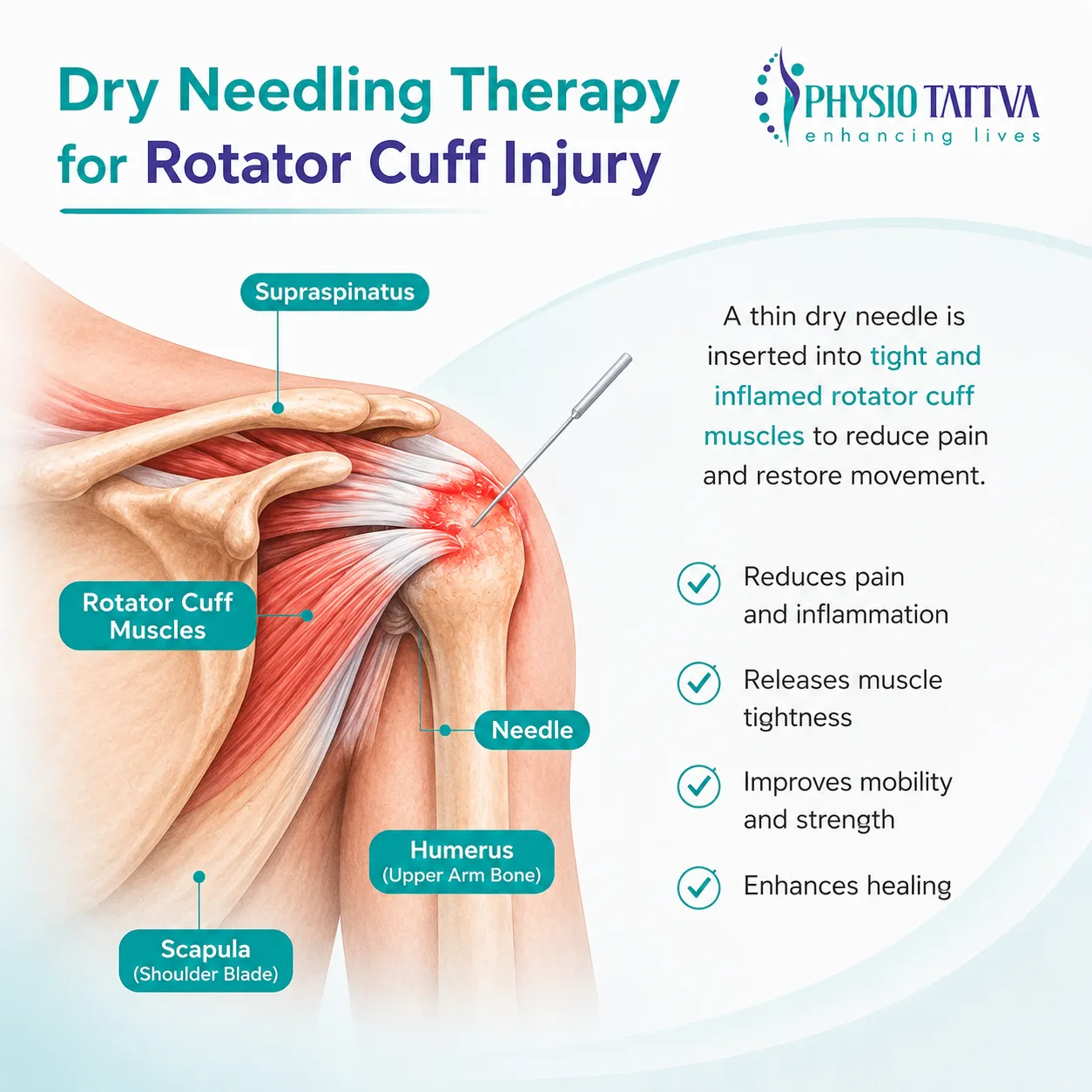
Dry needling is a skilled intervention performed by a trained physical therapist, chiropractor, or medical doctor. It involves inserting a thin, sterile, monofilament needle (an "acupuncture needle") directly into a myofascial trigger point.
The term "dry" signifies that nothing is injected into the body. The needle itself is the treatment. The goal is to elicit a "local twitch response", an involuntary spinal cord reflex where the muscle fibers contract and then relax. This twitch is the key to breaking the pain cycle.
How Does Dry Needling Work for the Rotator Cuff?
When used as part of a physiotherapy program for shoulder injuries, dry needling works by directly targeting dysfunctional muscle tissue that contributes to rotator cuff pain and restricted movement. This technique provides relief through several well-established mechanisms:
- Releases Trigger Points: The needle mechanically disrupts tight muscle knots, allowing contracted fibers to lengthen, relax, and restore normal muscle tone.
- Elicits a Local Twitch Response: This involuntary reflex temporarily fatigues dysfunctional muscle fibers, helping them release tension and “reset” to a healthier resting state.
- Improves Blood Flow: Needle insertion creates a controlled, localized inflammatory response, signaling the body to increase circulation and deliver oxygen and nutrients essential for tissue healing.
- Pain Modulation: Dry needling stimulates sensory nerve fibers that help block pain signals traveling to the brain, often providing immediate pain relief.
For a rotator cuff injury, a physiotherapist carefully assesses shoulder mechanics to identify trigger points in the supraspinatus, infraspinatus, and surrounding stabilizing muscles that contribute to pain, weakness, and shoulder impingement.
Benefits of Dry Needling for Rotator Cuff Pain
When incorporated into a comprehensive physiotherapy treatment plan, dry needling can provide meaningful improvements in pain control, movement, and functional recovery. Patients often experience the following benefits:
- Targeted Pain Relief: Directly addresses the source of muscular pain by releasing deep trigger points that contribute to shoulder discomfort.
- Improved Range of Motion: Relaxing tight and overactive muscles allows the shoulder joint to move more freely and with less restriction.
- Accelerated Recovery: Reduced pain and improved muscle function enable patients to participate more effectively in strengthening and rehabilitation exercises.
- Reduced Muscle Tension: Alleviates chronic tightness, muscle guarding, and compensatory patterns commonly associated with rotator cuff injuries.
Dry Needling vs. Acupuncture: What's the Difference?
Dry needling and acupuncture often get confused because both use very thin needles. However, they are based on entirely different philosophies and are used for different purposes. The key difference lies in how and why the needles are applied.
Dry needling is a modern physiotherapy technique grounded in Western anatomy and neuroscience. It focuses on identifying and releasing myofascial trigger points within tight or dysfunctional muscles to reduce pain and restore movement, especially in conditions like rotator cuff injuries.
Acupuncture, in contrast, is rooted in Traditional Chinese Medicine (TCM). It aims to restore balance in the body by regulating the flow of “Qi” (energy) through specific pathways known as meridians.
Key Differences at a Glance: To better understand how these two approaches differ in practice, here are the key distinctions:
- Philosophy: Dry needling is based on Western neuroanatomy and scientific principles, while acupuncture follows Traditional Chinese Medicine concepts.
- Primary Goal: Dry needling targets muscle trigger points to relieve pain and improve function, whereas acupuncture aims to balance energy flow throughout the body.
- Technique: Dry needling involves inserting needles directly into tight or painful muscle tissue, while acupuncture places needles at specific points along energy meridians.
In simple terms, dry needling is a muscle-focused treatment for shoulder pain and movement limitations, whereas acupuncture is a holistic therapy centered on overall energy balance.
What to Expect During and After a Session
Understanding what happens during and after a dry needling session can help ease anxiety and set realistic expectations. The procedure is quick, carefully controlled, and performed by trained physiotherapists to ensure safety and comfort throughout the treatment.
During the Session
A typical dry needling session follows a structured process focused on accuracy and patient comfort:
- Assessment: Your therapist will palpate your shoulder muscles to locate the specific trigger points causing your symptoms.
- Insertion: The area will be cleaned, and the therapist will insert the sterile needle. You may feel a small prick, but often very little.
- Twitch Response: As the needle reaches the trigger point, you may feel a deep ache or the characteristic muscle twitch. This sensation is brief but confirms the needle is in the right spot.
- Removal: The needle is left in for a very short time—from a few seconds to a couple of minutes—before being removed.
What to Expect After Dry Needling
It is common to experience post-treatment soreness, similar to the feeling after an intense workout. This can last for 24-48 hours. Your therapist may recommend:
- Gentle stretching
- Applying heat to the area
- Staying hydrated
- Avoiding strenuous activity for the rest of the day
Is Dry Needling Right for You? Safety, Risks, and Key Considerations
Dry needling therapy for rotator cuff injury is generally safe and effective when performed by a trained physiotherapist. It is especially beneficial for individuals whose shoulder pain is driven by muscle tightness, trigger points, and related movement dysfunction rather than structural tears alone.
Contraindications (Who Should Avoid Dry Needling)
Certain conditions may make dry needling unsuitable or require extra caution. Dry needling may not be recommended for:
- People with a significant needle phobia.
- Those on anticoagulant (blood-thinning) medication.
- Areas with an active infection or skin lesion.
- The first trimester of pregnancy.
Potential Risks and Side Effects
While risks are minimal, it is important to be aware of possible side effects associated with dry needling:
- Most Common: Bruising, minor bleeding, and temporary soreness.
- Rare: Fainting, infection, or pneumothorax (collapsed lung) if needling is performed improperly near the chest wall. A trained professional is skilled in avoiding this.
Rotator Cuff Pain Relief with Dry Needling at Physiotattva
Dry needling therapy for rotator cuff injury is not a miracle cure, but it is a highly effective tool for providing rotator cuff pain relief and accelerating recovery. By releasing deep muscle tension and deactivating painful trigger points, it creates a window of opportunity to restore normal movement and build strength.
If you are struggling with persistent shoulder pain, consult a qualified physical therapist to see if this modern, evidence-based shoulder pain treatment can help you get back to a pain-free life.
At Physiotattva physiotherapy clinics in Bangalore and Hyderabad, you receive personalised care tailored to your specific needs, ensuring effective results and comfort throughout your journey to recovery.
Don’t wait to start your recovery! Get in touch with Physiotattva for more details! Contact us at +91 89510 47001.
Why Physiotattva?
22+
50,000+
95%
200+
25+
4.8
Cities We Serve

Bangalore
At Physio Tattva, we are committed to bring access to quality physio care through ultra-modern clinics and high-skilled practitioners to all.
.webp)
Hyderabad
At Physio Tattva, we are committed to bring access to quality physio care through ultra-modern clinics and high-skilled practitioners to all.
.webp)
Vishakhapatnam
At Physio Tattva, we are committed to bring access to quality physio care through ultra-modern clinics and high-skilled practitioners to all.
Core Treatments
Core Conditions
Core Symptoms
Frequently Asked Questions
Is dry needling painful?

How many dry needling therapy sessions will I need for my rotator cuff injury?
Are there any side effects of dry needling for Rotator Cuff injury?
Can anyone perform dry needling?






%20(1)-p-3200.jpeg)


.jpg)
.webp)
.webp)
.webp)