




Gentle manual therapy plays an important supportive role in osteoporosis care by focusing on pain relief, postural correction, mobility improvement, and fall-risk reduction without placing stress on fragile bones. When applied by trained physiotherapists, these techniques help improve movement confidence and overall quality of life while prioritising safety at every stage.
This article will explore how manual therapy is safely used in osteoporosis management, the techniques that are recommended and avoided, and how it fits into a comprehensive rehabilitation programme designed to support long-term bone health and functional independence.
How Manual Therapy Is Safely Applied in Osteoporosis Care?
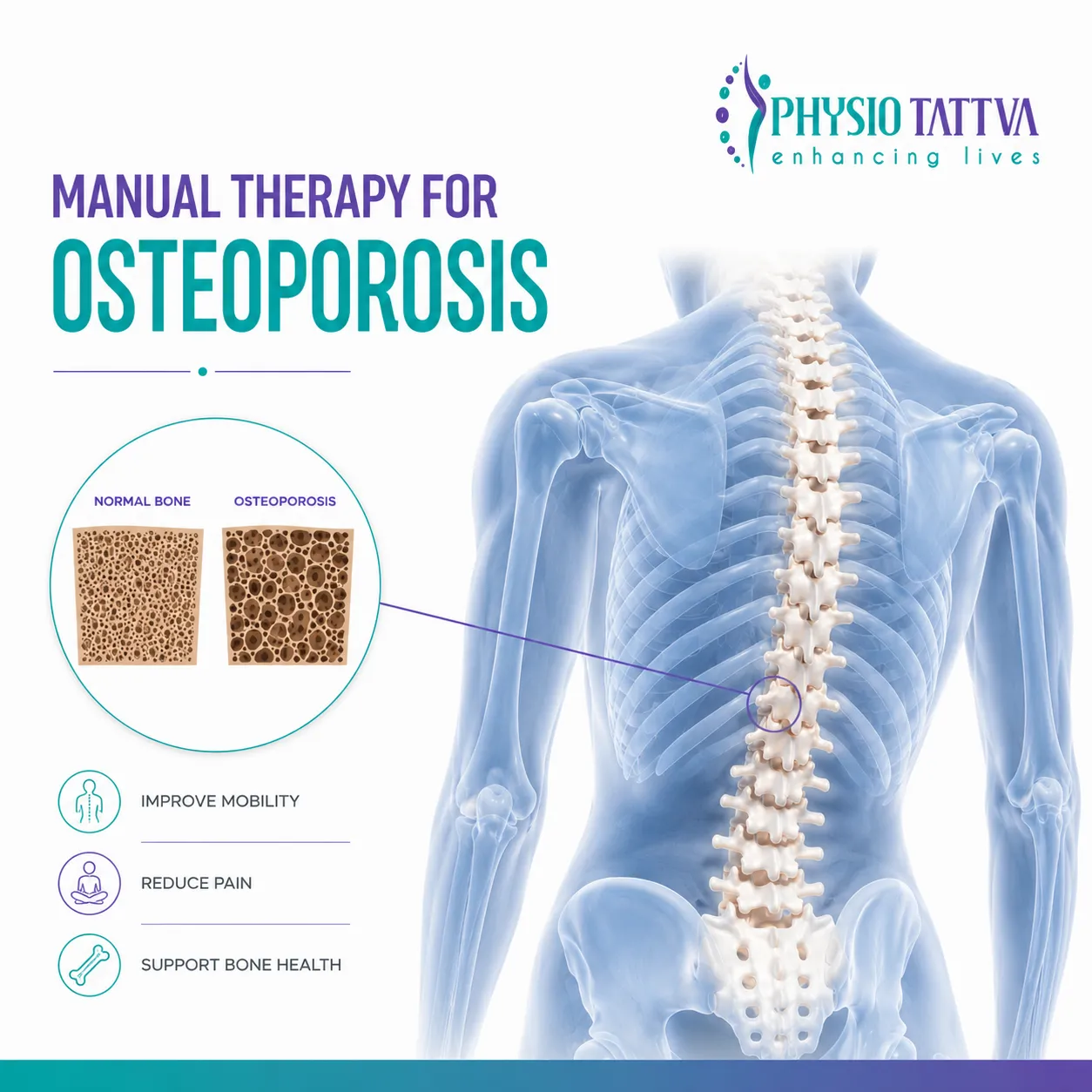
Manual therapy for individuals with osteoporosis is not intended to treat the bone density itself but is highly effective for managing the secondary consequences of the disease. The core principle is "First, do no harm." The approach must shift from aggressive, corrective techniques to gentle, supportive interventions.
- Primary Goals: Manage pain, improve mobility, correct posture (especially thoracic kyphosis), and enhance muscle function without compromising skeletal integrity.
- Absolute Contraindications: High-Velocity, Low-Amplitude (HVLA) thrust manipulations ("cracking"), forceful joint mobilizations, and deep, percussive techniques are strictly forbidden due to high fracture risk.
- Recommended Techniques: Gentle soft tissue mobilization, myofascial release, low-grade joint mobilizations (Grades I-II), and muscle energy techniques are the safest and most effective options.
- Holistic Approach: Manual therapy is most effective when integrated with a comprehensive program of weight-bearing exercise, resistance training, balance work, and patient education on fall prevention and safe movement.
Understanding the Core Challenge
Osteoporosis is a metabolic bone disease characterized by low bone mass and micro-architectural deterioration of bone tissue, leading to enhanced bone fragility and a consequent increase in fracture risk. Applying external force (manual therapy) to a system that is inherently fragile requires extreme caution and a modified approach.
The primary risk is iatrogenic fracture, most commonly a vertebral compression fracture (VCF) or a rib fracture, from a seemingly benign technique.
The Goals of Manual Therapy in Osteoporosis Management
The focus shifts from "fixing" a joint to managing the musculoskeletal environment around the fragile skeleton.
- Pain Management: Address myofascial pain and muscular tension resulting from postural changes and guarding. For example, tight pectoral muscles and overstretched, weak back extensors in a patient with thoracic kyphosis.
- Improve Joint Mobility: Gently restore mobility in stiff but stable joints, particularly the thoracic spine and ribs. Improved thoracic mobility can enhance breathing mechanics, reduce neck and shoulder pain, and facilitate better posture.
- Postural Correction: Target key muscle groups that contribute to the forward-stooped posture (kyphosis) common in osteoporosis. This involves lengthening tight anterior structures (pectorals, hip flexors) and facilitating activation of posterior structures (thoracic extensors, glutes).
- Enhance Body-Awareness (Proprioception): Gentle manual cues can help patients better understand their body position in space, which is a crucial component of fall prevention.
Safety Precautions & Contraindications for Manual Thearpy
This is the most important section. A thorough patient history is non-negotiable, including a review of T-scores from a DEXA scan and any history of fractures.
Absolute Contraindications (DO NOT DO)
In individuals with osteoporosis, certain manual therapy techniques carry an unacceptably high risk of fracture and must be strictly avoided at all times:
- High-Velocity, Low-Amplitude (HVLA) Thrusts: Any technique involving a rapid "thrust" or "crack" over the spine, ribs, or pelvis is absolutely contraindicated. The brittle bone cannot withstand the sudden force.
- Forceful End-Range Mobilization (Grades III-V): Pushing a joint to its end-range with overpressure is unsafe.
- Long-Lever Techniques: Avoid using a patient's leg or arm as a long lever to mobilize the spine or pelvis (e.g., certain lumbar roll techniques).
- Aggressive Soft Tissue Techniques: Deep, percussive massage (tapotement) or techniques using elbows and knuckles directly over bone (spinous processes, ribs) should be avoided.
Relative Contraindications & Precautions
These situations do not always prohibit manual therapy, but they require a highly modified, conservative approach and close clinical judgement:
- Severe Osteoporosis (T-score < -2.5): Requires the gentlest approach.
- History of Fracture: Be especially cautious around areas with previous fractures, even if healed.
- Patient on Long-Term Corticosteroids: These medications can further degrade bone quality.
- Thoracic Flexion: Avoid any technique or position that forces the patient into deep spinal flexion, as this increases anterior vertebral loading and the risk of compression fracture.
Recommended (Safe and Effective) Manual Therapy Techniques
When treating individuals with osteoporosis, the guiding principle is to use gentle, indirect, and patient-led techniques that minimise load on fragile bones while effectively addressing pain, stiffness, and postural strain. The following approaches are considered both safe and effective when applied by trained professionals.
Soft Tissue Mobilization (STM)
This technique focuses on reducing muscular tension and improving comfort without applying stress to bone structures.
- Technique: Use broad, flat-hand strokes (effleurage) and gentle kneading (petrissage) to reduce general muscle tension.
- Targets: Focus on the muscles, not the bones. Key targets include the pectoralis major/minor, upper trapezius, suboccipitals, and hip flexors. This helps to combat the kyphotic posture.
Myofascial Release (MFR)
MFR is a slow, low-load technique designed to improve tissue extensibility safely.
- Technique: Apply gentle, sustained pressure into a fascial restriction to allow for viscoelastic lengthening. It is a slow, low-load technique that is generally very safe.
Gentle Joint Mobilization (Grades I and II)
These mobilisations are used primarily for pain relief and subtle mobility improvements, not for forceful joint correction.
- Technique: Use small-amplitude, oscillatory movements well within the available range of motion.
- Grade I: Small amplitude at the beginning of the range. Used for pain relief.
- Grade II: Large amplitude within the mid-range. Used for pain relief and gentle mobility.
- Targets: Excellent for improving segmental mobility in the thoracic spine to promote extension.
Muscle Energy Techniques (MET)
MET relies on active patient participation, making it one of the safest manual therapy options for osteoporosis.
- Technique: The clinician positions a joint at its restrictive barrier, and the patient performs a gentle, voluntary isometric contraction against the clinician's resistance. Following the contraction, the patient relaxes, and a new restrictive barrier is gently engaged.
- Why it's ideal: It is an active technique, meaning the patient controls the amount of force generated. This is inherently safer than a passive technique. It is highly effective for improving mobility in the ribs, spine, and pelvis.
Integration with a Comprehensive Rehabilitation Program
Manual therapy for osteoporosis should always be viewed as a supportive and preparatory intervention, rather than a standalone treatment. Its primary role is to reduce pain, improve mobility, and prepare the body for a safe and effective rehabilitation programme. For optimal outcomes, it must be integrated with the following key components:
- Weight-Bearing Exercise: The cornerstone of building and maintaining bone density (e.g., walking, dancing, stair climbing).
- Resistance Training: Strengthens muscles that support the skeleton, especially the back extensors, which directly counteracts kyphosis and reduces vertebral load.
- Balance & Proprioception: Essential for fall prevention, the leading cause of osteoporotic fractures (e.g., Tai Chi, single-leg stance).
- Patient Education: Teach safe movement strategies for daily life, such as the "hip hinge" for lifting instead of spinal flexion, and "log rolling" to get out of bed.
Enhancing Quality of Life Through Safe Osteoporosis Management
Manual therapy plays a valuable supportive role in the management of osteoporosis when applied with the right clinical judgement and safety-first approach. While it does not alter bone density directly, it is highly effective in reducing pain, improving mobility, correcting posture, and enhancing muscle function around a fragile skeletal system. By prioritising gentle, low-risk techniques and avoiding high-force interventions, manual therapy helps patients move with greater confidence and comfort. When integrated with weight-bearing exercise, strength training, balance work, and patient education, it contributes meaningfully to fall prevention and long-term independence. Under professional supervision, manual therapy becomes an important component of holistic osteoporosis rehabilitation and quality-of-life improvement.
At Physiotattva physiotherapy clinics in Bangalore and Hyderabad, you receive personalised care tailored to your specific needs, ensuring effective results and comfort throughout your journey to recovery.
Don’t wait to start your recovery! Get in touch with Physiotattva for more details! Contact us at +91 89510 47001.
Why Physiotattva?
22+
50,000+
95%
200+
25+
4.8
Cities We Serve

Bangalore
At Physio Tattva, we are committed to bring access to quality physio care through ultra-modern clinics and high-skilled practitioners to all.
.webp)
Hyderabad
At Physio Tattva, we are committed to bring access to quality physio care through ultra-modern clinics and high-skilled practitioners to all.
.webp)
Vishakhapatnam
At Physio Tattva, we are committed to bring access to quality physio care through ultra-modern clinics and high-skilled practitioners to all.
Core Treatments
Core Conditions
Core Symptoms
Frequently Asked Questions
Is manual therapy for osteoporosis painful?

Can manual therapy cure my osteoporosis?
How do I know if the physiotherapist is qualified?
Is this safe if I've already had an osteoporotic fracture?




%20(1)-p-3200.jpeg)


.jpg)
.webp)
.webp)
.webp)