Kinesio Taping Therapy for Achilles Tendon Rupture
Kinesio taping therapy can support Achilles tendon rupture recovery by reducing swelling, easing pain, and improving ankle awareness during rehabilitation. This guide explains how taping works, when it’s used across recovery phases, and how it safely complements physiotherapy-led treatment plans.
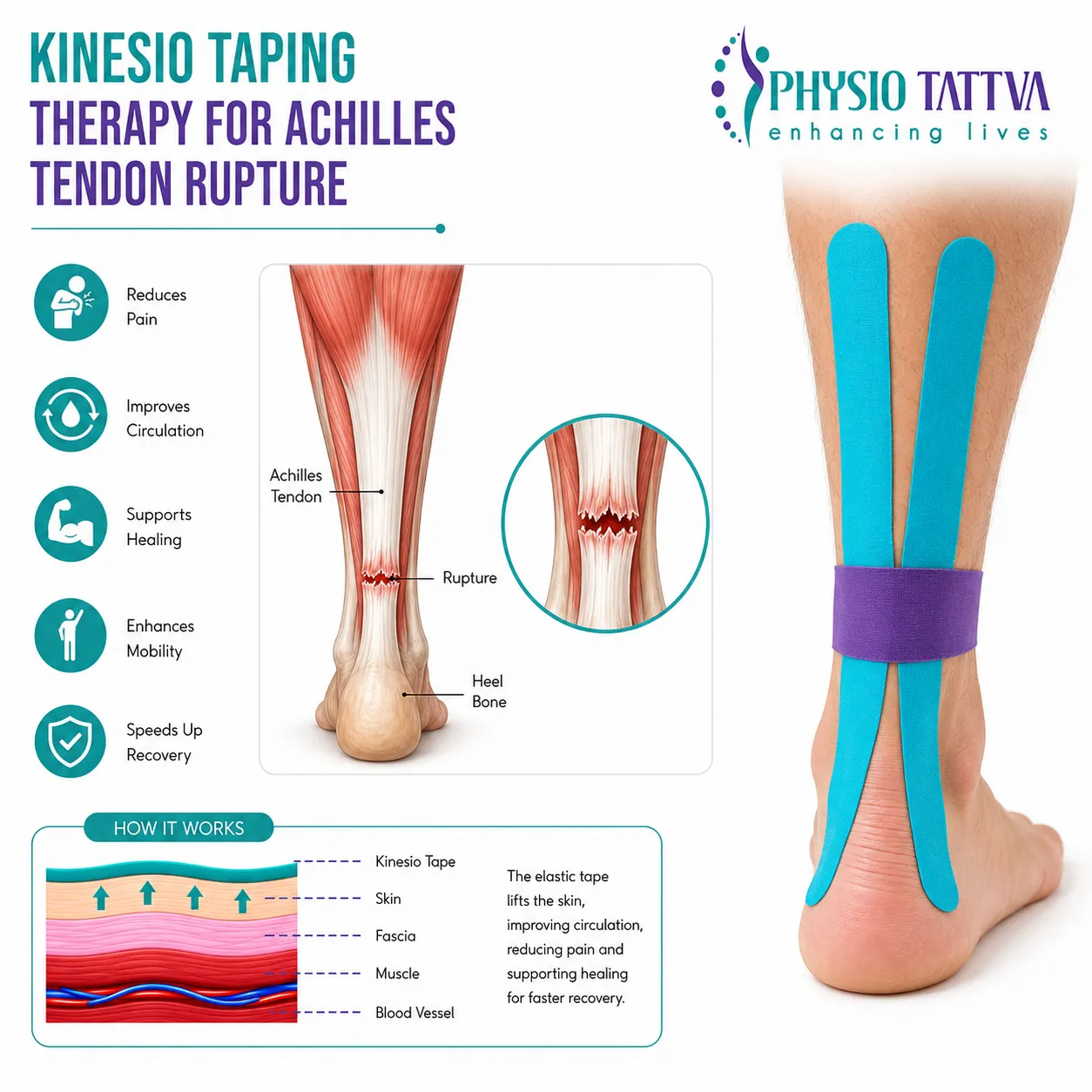
An Achilles tendon rupture is a serious injury that demands a carefully structured and extended rehabilitation programme, whether treated surgically or conservatively. As part of a comprehensive physiotherapy approach, Kinesio taping therapy can help manage pain, reduce swelling, and provide functional support during recovery.
This article explores how Kinesio taping supports Achilles tendon rupture rehabilitation, its benefits, application principles, and safe integration into physiotherapy care.
Primary Goals of Kinesio Taping for an Achilles Rupture
When applied correctly by a trained professional, Kinesio tape can help achieve several key objectives during the rehabilitation phases:
Reduce Swelling and Edema: By gently lifting the skin, the tape creates space in the subcutaneous layer, which can improve lymphatic drainage and blood flow. This is especially useful in the early post-immobilization phases when swelling is common.
Decrease Pain: The tape can alleviate pain by reducing pressure on underlying pain receptors (nociceptors) and providing novel sensory input that can override pain signals (Gate Control Theory).
Provide Proprioceptive Feedback: The tape on the skin provides continuous feedback to the brain about the position and movement of the ankle. This enhanced "body awareness" can help improve stability, prevent compensatory movements, and build confidence during gait training.
Inhibit Overuse of Compensatory Muscles: Often, other muscles (like the peroneals or tibialis posterior) work overtime to compensate for the weak Achilles. Taping can be used to inhibit these overactive muscles.
Gently Support or "Offload" the Tendon: While the elastic tape cannot provide rigid mechanical support like a brace, a specific application can serve as a tactile cue to limit excessive dorsiflexion (stretching of the tendon), effectively "offloading" some of the tension during movement.
Improve Scar Tissue Mobility (Later Stages): Once the surgical incision is fully healed, Kinesio tape can be applied over the scar to help promote more pliable and aligned scar tissue formation, reducing restrictions.
Common Kinesio Taping Techniques for Achilles Rupture
Several taping methods may be used during Achilles tendon rupture rehabilitation, depending on the healing stage, symptom severity, and functional goals. A physical therapist selects the most appropriate technique to address concerns such as swelling, pain, or ankle instability.
Technique 1: Swelling and Edema Reduction (Lymphatic Taping)
This approach focuses on improving lymphatic drainage and reducing persistent swelling around the ankle and lower calf, particularly during the early mobilisation phase.
Tape Cut: A "Fan Cut" or "Web Cut." A single piece of tape is cut into 4-6 thin "tails," leaving a solid base of about 2 inches.
Application: This technique is applied with minimal stretch to encourage fluid movement without restricting circulation.
The patient lies down with their leg elevated.
The solid base of the fan strip is anchored without stretch just above the swollen area (e.g., on the mid-calf), pointing towards the lymph nodes behind the knee (popliteal fossa).
The tails are then laid down without stretch over the swollen area, fanning out to cover the entire region.
Technique 2: Tendon Support and Offloading
This technique is primarily used to provide gentle support to the Achilles tendon and reduce excessive mechanical load during movement.
Tape Cut: An "I" strip or a "Y" strip.
Application (using a Y-Strip): The tape is applied with light tension to support the tendon while still allowing normal ankle movement.
The patient sits or lies with their foot hanging off a table, placed in a gentle stretch (slight dorsiflexion).
Measure a piece of tape from the bottom of the heel to the middle of the calf muscle. Cut the tape lengthwise into a "Y," leaving a 2-inch base.
Anchor the base of the "Y" without stretch to the bottom of the heel (calcaneus).
Apply the two "tails" of the Y-strip with a light (15-25%) stretch, running up along either side of the Achilles tendon, effectively "cradling" it.
Lay the ends of the tails down on the calf muscle without stretch.
Technique 3: Proprioceptive Support for Ankle Stability
This method is designed to enhance sensory feedback and improve ankle control during walking and functional activities.
Tape Cut: Two "I" strips.
Application: This application aims to improve joint awareness and guide ankle movement during weight-bearing tasks:
One strip is applied from the outside of the mid-foot, under the arch, and up the inside of the ankle, similar to a "stirrup."
A second strip can be applied in a "heel lock" or figure-eight pattern around the ankle to provide feedback against excessive inversion or eversion.
These strips are typically applied with light to moderate stretch over the joint line.
When to Use Kinesio Tape in the Rehabilitation Timeline
The timing of Kinesio taping is critical to ensure it supports healing rather than interferes with tendon repair. Its use is carefully matched to each stage of recovery, based on tissue healing, weight-bearing status, and functional goals.
Acute Phase (0-6 weeks): Typically, no taping is done. The leg is immobilized in a cast or boot to allow the tendon ends to heal together.
Early Mobilization Phase (approx. 6-12 weeks): This is the ideal time to start. As the patient transitions to partial weight-bearing in a boot, tape can be used for swelling control and to provide proprioceptive feedback.
Strengthening Phase (approx. 3-6 months): As the boot is removed and strengthening exercises (like calf raises) begin, taping can provide confidence and gentle offloading support.
Return to Sport Phase (6+ months): Tape can be used during activity to provide continued proprioceptive feedback and support as the tendon adapts to higher loads.
Important Considerations and Contraindications
While Kinesio taping is generally safe, correct application and patient suitability are essential to avoid skin irritation, ineffective support, or complications during recovery.
Skin Preparation and Application Guidelines
Proper skin preparation and correct taping technique ensure optimal adhesion, comfort, and therapeutic benefit.
Skin Preparation: Ensure the skin is clean, dry, and free of oils or lotions. Trim excessive hair for better adhesion and painless removal.
Application Technique: Always round the edges of the tape to prevent peeling. Rub the tape after application to activate the heat-sensitive adhesive.
Wear Duration: Kinesio tape can typically be worn for 3-5 days, including during showering.
Safe Removal: Remove the tape slowly and gently while pressing down on the skin. Soaking the tape in oil (baby oil or olive oil) or water can help reduce discomfort.
Contraindications: When Kinesio Taping Should Be Avoided
Kinesio tape should not be applied in certain medical conditions where it may pose risks or interfere with healing.
Integrated Achilles Tendon Rehabilitation with Kinesio Taping at Physiotattva
Kinesio taping therapy for Achilles tendon rupture is a safe and effective complementary treatment when used as part of a physical therapist-led rehabilitation program. Its primary benefits lie in managing pain and swelling, improving body awareness (proprioception), and providing the patient with psychological confidence as they return to activity. It does not replace the foundational elements of recovery—proper immobilization, progressive loading, and targeted strengthening—but it can significantly support and enhance the healing journey.
At Physiotattva physiotherapy clinics in Bangalore, Hyderabad and Vizag, you receive personalised care tailored to your specific needs, ensuring effective results and comfort throughout your journey to recovery.
Can Kinesio tape heal a ruptured Achilles tendon on its own?
No, absolutely not. Kinesio taping is a supportive, or adjunct, therapy. It cannot heal a ruptured tendon by itself. An Achilles tendon rupture is a severe injury that requires a comprehensive treatment plan from a medical professional, which may include surgery or a period of immobilisation (casting/booting). Kinesio tape is used alongside these primary treatments to help manage symptoms and support the area during the rehabilitation phase.
How does Kinesio taping help with an Achilles tendon rupture?
Kinesio taping supports recovery by providing gentle structural support to the affected tendon and surrounding calf muscles without restricting natural movement. By slightly lifting the skin, the tape helps improve blood flow and lymphatic drainage, which can reduce swelling and bruising. It also stimulates sensory nerves in the skin, helping to disrupt pain signals and ease discomfort. Additionally, kinesio taping enhances proprioception by improving awareness of ankle position, supporting better stability and coordination during weight-bearing activities.
When can I start using Kinesio tape after an Achilles rupture?
You must wait for clearance from your surgeon or physical therapist. Taping should never be done on an open wound or unsutured incision. Typically, Kinesio taping is introduced during the rehabilitation phase, after the initial period of immobilization (post-surgery or with conservative management), once you are cleared to begin gentle movement and weight-bearing exercises.






.webp)
.webp)

.jpeg)

.webp)







%20(1)-p-3200.jpeg)


.jpg)
.webp)
.webp)
.webp)