




Manual therapy plays a critical role in the rehabilitation of hamstring strains, helping to reduce pain, improve mobility, and promote faster healing. At Physiotattva, we use evidence-based techniques such as soft tissue mobilization, deep tissue massage, and transverse friction massage to address the different phases of recovery. From managing inflammation in the acute phase to remodeling scar tissue and restoring full function in the chronic phase, our personalized approach ensures that each treatment is tailored to your specific needs and healing progress.
Manual therapy works synergistically with a comprehensive rehabilitation program, including therapeutic exercises, to accelerate recovery, build strength, and improve muscle flexibility. Whether you're an athlete or simply dealing with a hamstring strain, Physiotattva's skilled physiotherapists in Bangalore and Hyderabad are here to guide you through every step of the recovery process.
Comprehensive Guide to Manual Therapy for Hamstring Strains
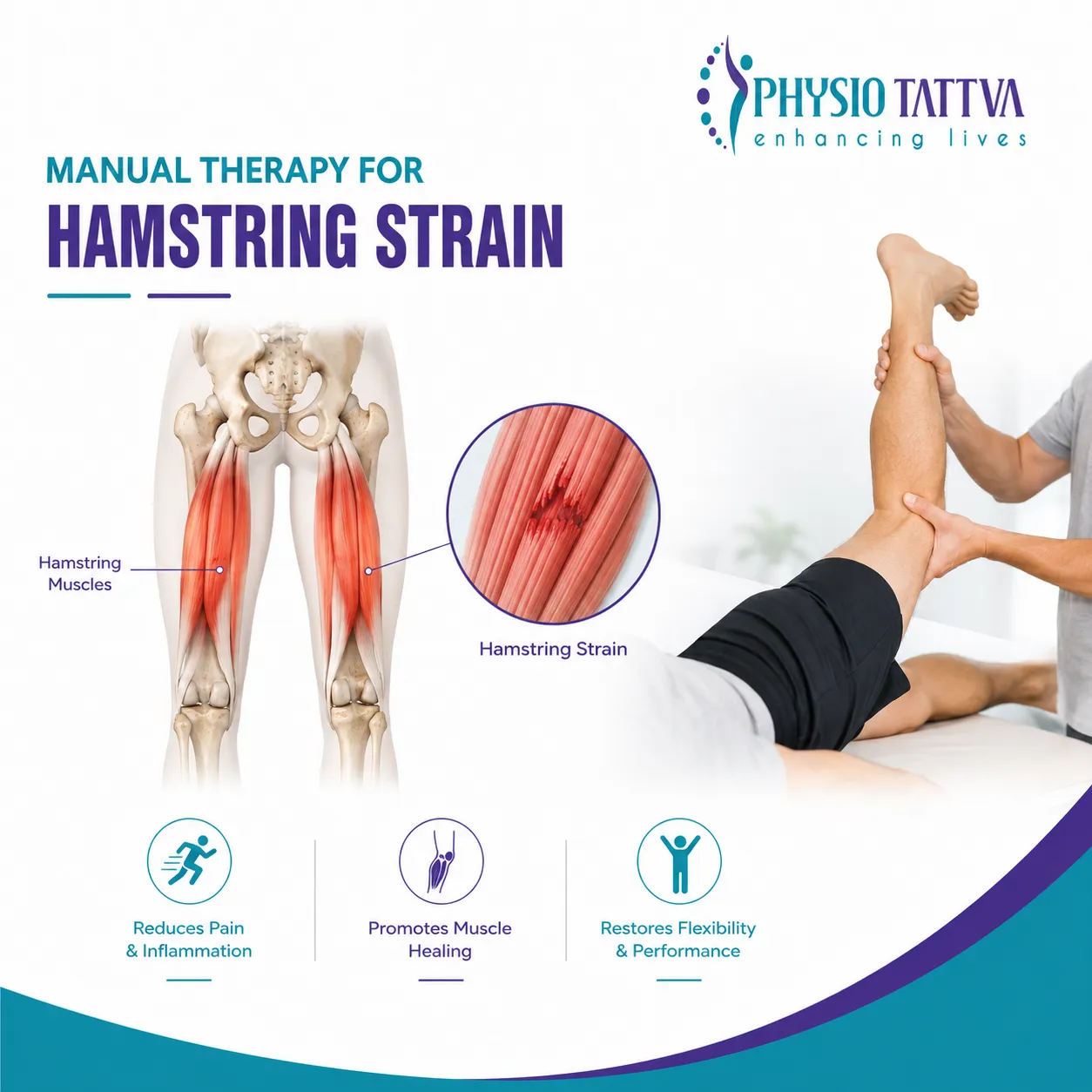
Manual therapy is a cornerstone of effective rehabilitation for hamstring strains (injuries to the biceps femoris, semitendinosus, or semimembranosus muscles). It involves skilled, hands-on techniques to diagnose and treat soft tissue and joint structures. Its primary goal is to optimise the healing environment, reduce pain, manage scar tissue, and restore normal function. By addressing these key aspects, manual therapy promotes faster, more effective recovery.
The application and intensity of manual therapy must be tailored to the grade of the strain (Grade 1, 2, or 3) and the phase of healing. This ensures that the treatment is both safe and effective, taking into account the stage of tissue repair and the patient's overall recovery progress.
Goals of Manual Therapy in Hamstring Strain Recovery
Manual therapy aims to address key aspects of the healing process, enhancing recovery and reducing the risk of long-term complications. The primary goals of manual therapy during hamstring strain recovery include:
- Pain and Spasm Reduction: Alleviates pain and protective muscle guarding.
- Inflammation and Edema Control: Promotes lymphatic drainage and reduces swelling, especially in the early stages.
- Improved Tissue Perfusion: Increases blood flow to the injured area, bringing oxygen and nutrients essential for repair.
- Scar Tissue Management: Prevents excessive, disorganised scar tissue (fibrosis) and promotes the alignment of new collagen fibres along the lines of stress.
- Restoration of Mobility: Improves muscle extensibility, fascial mobility, and joint range of motion at the hip and knee.
- Neuromuscular Re-education: Restores normal muscle firing patterns and reduces neural tension.
Manual Therapy Application by Phase of Healing
Manual therapy plays a vital role in the recovery process for hamstring strains, adapting its intensity and techniques according to the phase of healing. Each phase of recovery has specific goals, and manual therapy can help facilitate tissue repair, improve circulation, reduce pain, and ensure proper healing. Below is a breakdown of how manual therapy techniques are applied during each phase of the healing process:
Phase 1: Acute / Inflammatory Phase (Day 0-5)
During this phase, the primary goal is to protect the injury, manage pain and swelling, and prevent further damage. Manual therapy should be gentle and indirect.
Techniques
The following techniques are gentle and aimed at managing the early stages of inflammation, pain, and swelling, promoting healing without causing further strain to the injury.
- Gentle Effleurage: Light, long stroking movements performed proximal and distal to the injury site (not directly on it) to promote lymphatic drainage and reduce swelling.
- Pain-Free Gentle Isometrics: Sub-maximal muscle contractions with no joint movement can help with pain modulation and muscle activation.
- Cryotherapy Massage: Using an ice cup in a circular motion around the periphery of the injury site (avoiding the direct tear) for 5-7 minutes can help manage pain and inflammation.
- Contraindications: DO NOT perform deep tissue massage, aggressive stretching, or friction massage directly on the hematoma or injury site. This can increase bleeding and damage the fragile, newly forming tissue.
Phase 2: Subacute / Proliferation & Repair Phase (Day 3 - Week 3/6)
As inflammation subsides, the body begins laying down new collagen fibers (scar tissue). Manual therapy becomes crucial for ensuring this new tissue is strong and flexible.
Techniques
During this phase, manual therapy techniques become more specific and are aimed at promoting healing, reducing pain, and improving tissue flexibility.
- Soft Tissue Mobilisation (STM): More targeted strokes can be introduced to address specific areas of tension and improve circulation to the injured tissues.
- Petrissage (Kneading): Gentle lifting and squeezing of the muscle belly around the injury site to enhance circulation, reduce pain input from C-fibres, and facilitate tissue repair.
- Transverse Friction Massage (TFM): As tolerated, light-to-moderate cross-fibre friction can be initiated directly on the healing lesion. This helps align new collagen fibres and prevent adhesions between the muscle and its fascia. Start with short durations (1-2 minutes) and build up.
- Myofascial Release (MFR): Gentle, sustained pressure applied to the fascia surrounding the hamstrings, glutes, and adductors to release restrictions and improve tissue glide.
- Trigger Point Therapy: Locating and releasing hyperirritable spots (trigger points) in the hamstring or compensatory muscles (glutes, adductors, calf) using static compression.
- Nerve Gliding (Neurodynamics): If sciatic nerve irritation is present (common with proximal strains), gentle sciatic nerve flossing/gliding can be initiated to restore normal nerve mechanics.
Phase 3: Chronic / Remodelling Phase (Week 3+ to Months)
The tissue is now stronger and can withstand more mechanical stress. The goal is to remodel the scar tissue, restore full strength and extensibility, and prepare for a return to sport. Manual therapy can become more vigorous.
Techniques
During the chronic phase, manual therapy techniques are applied more aggressively to address long-term tissue restrictions and prepare the muscle for activity.
- Deep Tissue Massage: Deep, slow strokes applied along the length of the muscle fibers to release chronic tension and break down remaining adhesions.
- Aggressive Transverse Friction Massage: Deeper and more vigorous application to ensure the scar is mobile and pliable.
- Instrument Assisted Soft Tissue Mobilization (IASTM): Using tools (like Graston® or RockBlades®) to detect and treat fascial restrictions and fibrotic tissue more effectively than hands alone. Excellent for breaking down stubborn scar tissue.
- Muscle Energy Techniques (MET): A technique where the patient actively contracts the hamstring against the therapist's resistance, followed by a stretch. This is excellent for resetting muscle tone and improving range of motion (e.g., Post-Isometric Relaxation).
- Active Release Technique (ART®): A movement-based technique where the therapist applies tension to a muscle while the patient actively moves it from a shortened to a lengthened position. This is highly effective at breaking up adhesions.
- Joint Mobilisation: Assessing and treating any mobility restrictions in the lumbar spine, sacroiliac (SI) joint, or hip, as these can contribute to hamstring dysfunction.
Integration with a Comprehensive Rehab Program
Manual therapy is most effective when integrated with a progressive therapeutic exercise program. The combination of these two approaches enhances the recovery process and ensures long-term benefits. For example, manual therapy techniques aimed at reducing pain and increasing blood flow should be paired with pain-free isometric exercises, such as gentle heel digs. To improve tissue extensibility, gentle, pain-free stretching exercises (both static and dynamic) complement manual therapy’s role. Aligning scar tissue and building strength can be supported through eccentric exercises like Nordic curls and single-leg Romanian deadlifts (RDLs). Finally, to restore neuromuscular control, proprioception and agility drills, such as balance exercises and running drills, are essential in retraining the muscle for functional movement. By combining manual therapy with these exercise components, patients achieve more comprehensive and effective rehabilitation.
Important Considerations and Contraindications for Manual Therapy in Hamstring Strain
When applying manual therapy for hamstring strains, it is essential to consider several key factors to ensure safe and effective treatment. The following points should be kept in mind:
- Accurate Diagnosis: A thorough assessment is critical to confirm the grade of the strain and rule out other pathologies (e.g., avulsion fracture, referred pain from the lumbar spine).
- Pain is the Guide: Manual therapy should never cause sharp, debilitating pain. Some discomfort during deep techniques is normal, but it should be manageable and resolve quickly.
- Qualified Professional: These techniques require a deep understanding of anatomy, physiology, and pathology. They should only be performed by a licensed Physical Therapist, Athletic Trainer, or other qualified healthcare provider.
- Absolute Contraindications: Active infection, deep vein thrombosis (DVT), unhealed fractures, and Grade 3 (complete) ruptures requiring surgical consultation.
Get Back on Track Faster with Manual Therapy at Physiotattva
Manual therapy is a highly effective treatment for hamstring strains, offering numerous benefits during each phase of recovery. By incorporating techniques like soft tissue mobilization, deep tissue massage, and transverse friction, manual therapy accelerates healing, reduces pain, and improves muscle function. When integrated with a comprehensive rehabilitation program, including therapeutic exercises, manual therapy ensures a faster, safer recovery.
At Physiotattva physiotherapy clinics in Bangalore and Hyderabad, you receive personalised care tailored to your specific needs, ensuring effective results and comfort throughout your journey to recovery.
Don’t wait to start your recovery! Get in touch with Physiotattva for more details! Contact us at +91 89510 47001.
Why Physiotattva?
22+
50,000+
95%
200+
25+
4.8
Cities We Serve

Bangalore
At Physio Tattva, we are committed to bring access to quality physio care through ultra-modern clinics and high-skilled practitioners to all.
.webp)
Hyderabad
At Physio Tattva, we are committed to bring access to quality physio care through ultra-modern clinics and high-skilled practitioners to all.
.webp)
Vishakhapatnam
At Physio Tattva, we are committed to bring access to quality physio care through ultra-modern clinics and high-skilled practitioners to all.
Core Treatments
Core Conditions
Core Symptoms
Frequently Asked Questions
Is manual therapy painful for an active hamstring strain?

How soon after my injury can I start manual therapy?
Can't I just stretch the injury away?


%20(1)-p-3200.jpeg)

.jpg)
.webp)
.webp)
.webp)