




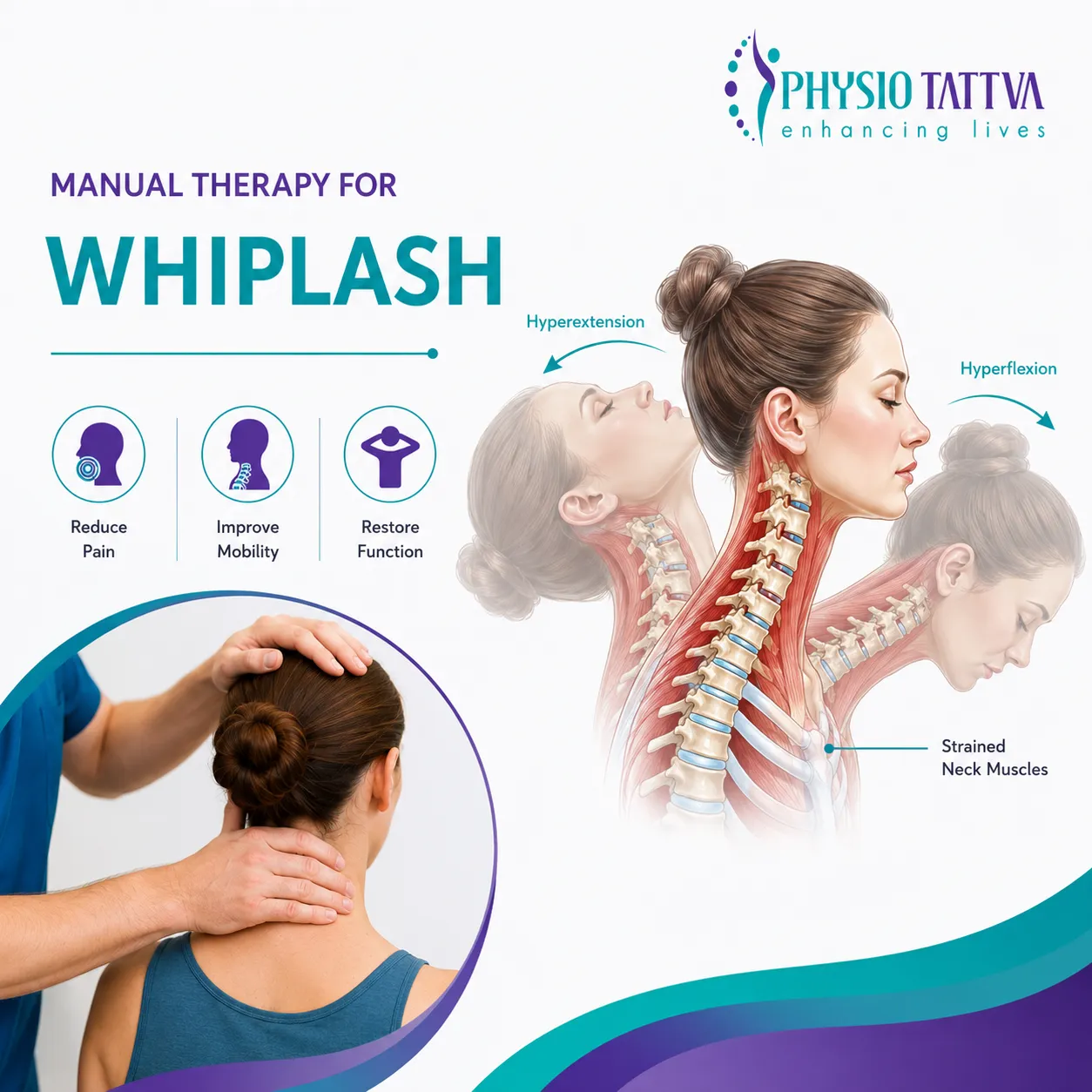
Whiplash is a common yet complex injury, most often associated with rear-end car accidents. The sudden, forceful back-and-forth movement of the neck can injure bones, discs, ligaments, muscles, and nerves, leading to a condition known as Whiplash-Associated Disorder (WAD). While rest was once the primary recommendation, modern evidence points to active recovery, with manual therapy for whiplash being a cornerstone of effective treatment.
This guide explores what manual therapy is, the specific techniques used for whiplash, and why it is so beneficial for recovery.
What is Manual Therapy?
Manual therapy is a specialized form of physical therapy where clinicians use their hands to diagnose and treat musculoskeletal conditions. Instead of relying solely on machines or equipment, the practitioner uses skilled, hands-on techniques to work on soft tissues and joints.
The primary goals of using manual therapy for whiplash are to:
- Reduce pain and inflammation
- Decrease muscle spasm and tension
- Restore normal range of motion in the neck and upper back
- Improve joint mechanics
- Promote faster healing and functional recovery
Key Types of Manual Therapy Used for Whiplash
A practitioner will use a combination of techniques tailored to the patient's specific presentation, stage of injury (acute vs. chronic), and tolerance.
Soft Tissue Mobilization
This category focuses on the muscles, fascia, ligaments, and tendons that have been strained or sprained.
- Therapeutic Massage: This is more than a relaxation massage. Techniques like deep tissue massage, trigger point therapy, and cross-friction massage are used to break down scar tissue (adhesions), reduce painful muscle knots (trigger points), and improve blood flow to the injured area.
- Myofascial Release: The fascia is a web of connective tissue that surrounds muscles. After a whiplash injury, it can become tight and restricted, causing pain and stiffness. Myofascial release involves applying sustained, gentle pressure to release these restrictions and restore mobility.
- Strain-Counterstrain: This is a very gentle technique where the practitioner moves the patient's neck into a position of maximum comfort or "ease." Holding this position for about 90 seconds helps reset the neural reflexes that cause muscle spasms, effectively "turning off" the tightness.
Joint Mobilization
After a whiplash injury, the small facet joints in the cervical (neck) and thoracic (upper back) spine can become stiff and painful.
- Joint Mobilization: This involves slow, passive movements of the spinal joints. The practitioner applies gentle, rhythmic pressure to a specific joint to improve its mobility (arthrokinematics) and reduce pain signals. This is a highly controlled and safe technique suitable for most whiplash cases.
Joint Manipulation (Spinal Adjustment)
- High-Velocity, Low-Amplitude (HVLA) Thrust: This is the technique most people associate with chiropractors—a quick, precise thrust that often produces an audible "pop." This can be effective for restoring motion to a "locked" joint.
- Important Consideration: Manipulation is generally not recommended in the very acute phase (first few days) of a severe whiplash injury due to potential instability or inflammation. A thorough assessment is crucial to determine if and when this technique is appropriate.
Manual Traction
In this technique, the therapist uses their hands to apply a gentle, sustained pulling force to the neck. This helps to decompress the joints and discs, which can provide significant relief if a nerve root is being irritated.
Muscle Energy Techniques (MET)
MET is an active technique where the patient participates. The practitioner positions the neck at a point of restriction, and the patient gently contracts the tight muscle against the practitioner's resistance for a few seconds. When the patient relaxes, the practitioner can gently stretch the muscle further. This process helps to lengthen tight muscles and restore joint mobility.
What to Expect During a Manual Therapy Session
Each manual therapy session begins with a clear assessment and progresses through targeted, hands-on care. A typical session includes the following steps
- Thorough Assessment: Your first session will involve a detailed history of the accident and your symptoms. The therapist will perform a physical examination to assess your neck's range of motion, muscle strength, reflexes, and pain patterns.
- Hands-On Treatment: Based on the assessment, the practitioner will use a combination of the techniques described above. Communication is key—you should always tell your therapist if a technique is causing sharp pain.
- Paired with Exercise: Manual therapy for whiplash is most effective when it's part of a comprehensive treatment plan. The hands-on work "prepares" the tissue to move correctly, and therapeutic exercise "teaches" it how to function again. You will almost always be given specific stretching and strengthening exercises to perform at home.
Benefits of Manual Therapy for Whiplash Recovery
When used as part of a physiotherapy programme, manual therapy provides the following recovery benefits
- Targeted Pain Relief: Directly addresses the source of pain, whether it’s a stiff joint or a tight muscle.
- Faster Return to Function: By restoring mobility and reducing pain it helps you get back to your daily activities sooner.
- Non-Invasive: It is a conservative treatment that can reduce the need for pain medication or more invasive procedures.
- Improved Proprioception: Hands-on treatment helps retrain the nerves that control your sense of position and movement, which is often impaired after whiplash.
- Prevents Chronic Issues: By addressing scar tissue and dysfunctional movement patterns early, manual therapy can help prevent the development of chronic neck pain and headaches.
Finding a Qualified Practitioner
To ensure safe and effective treatment, seek a licensed healthcare professional with specialized training in manual therapy. Look for:
- Physical Therapists (PT): Especially those with credentials like OCS (Orthopaedic Clinical Specialist) or FAAOMPT (Fellow of the American Academy of Orthopaedic Manual Physical Therapists).
- Chiropractors (DC): They specialize in spinal manipulation and other manual techniques.
- Osteopathic Physicians (DO): They are fully licensed physicians with additional training in hands-on diagnosis and treatment.
Restoring Neck Function After Whiplash with Physiotattva
If you are suffering from a whiplash injury, proactive treatment is crucial for a full recovery. Manual therapy for whiplash is a safe, evidence-based approach that addresses the root causes of pain and stiffness. When performed by a skilled practitioner and combined with a tailored exercise program, it can significantly accelerate your healing, restore function, and help you put neck pain in the rearview mirror.
At Physiotattva physiotherapy clinics in Bangalore and Hyderabad, you receive personalised care tailored to your specific needs, ensuring effective results and comfort throughout your journey to recovery.
Don’t wait to start your recovery! Get in touch with Physiotattva for more details! Contact us at +91 89510 47001.
Why Physiotattva?
22+
50,000+
95%
200+
25+
4.8
Cities We Serve

Bangalore
At Physio Tattva, we are committed to bring access to quality physio care through ultra-modern clinics and high-skilled practitioners to all.
.webp)
Hyderabad
At Physio Tattva, we are committed to bring access to quality physio care through ultra-modern clinics and high-skilled practitioners to all.
.webp)
Vishakhapatnam
At Physio Tattva, we are committed to bring access to quality physio care through ultra-modern clinics and high-skilled practitioners to all.






%20(1)-p-3200.jpeg)


.jpg)
.webp)
.webp)
.webp)