




When you suffer a sprain or a strain, your primary goals are to manage pain, reduce swelling, and support the injured area to promote healing. While rest, ice, and compression are staples of recovery, Kinesio taping therapy for sprains and strains has emerged as a powerful, complementary treatment used by physical therapists, athletic trainers, and clinicians worldwide.
This article will break down everything you need to know about using Kinesiology tape (often called KT tape) for these common injuries.
Sprains vs Strains: Understanding the Difference
Before applying Kinesio tape, it’s important to know whether you’re managing a sprain or a strain, as each affects different tissues and may require a different taping approach.
Sprains
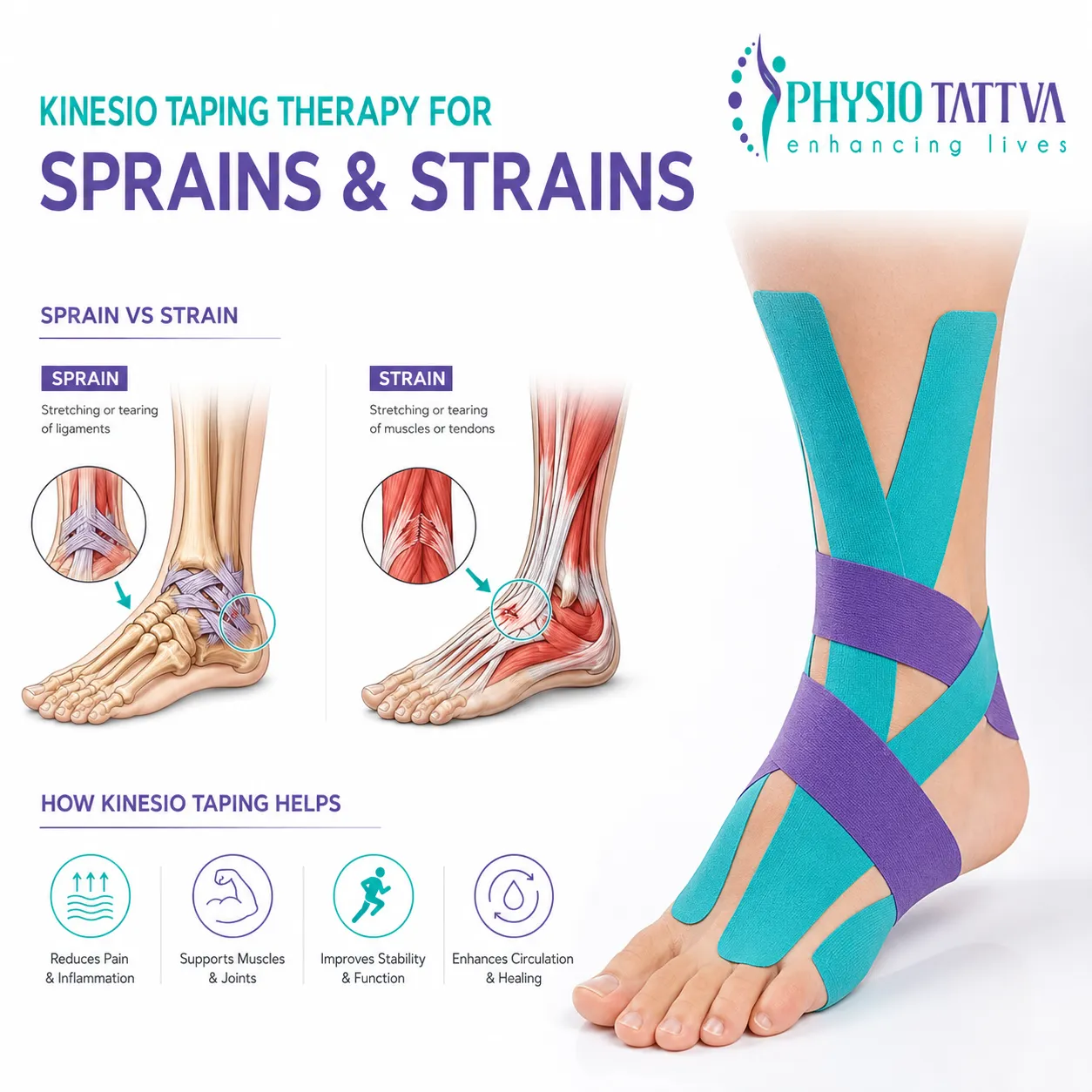
A sprain affects the ligaments that stabilise your joints, and understanding how it happens helps guide proper taping and recovery.
- Involves an injury to a ligament, the strong tissue connecting one bone to another.
- Occurs when the ligament is overstretched or torn due to sudden twists or impact.
- Common examples include ankle sprains, knee sprains, and wrist sprains.
- Typical symptoms: swelling, bruising, joint instability, and pain during movement or weight-bearing.
Strains
A strain impacts muscles or tendons, and knowing the mechanism of injury helps determine the right taping approach.
- Involves an injury to a muscle or tendon, which connects muscle to bone and enables movement.
- Happens when the muscle or tendon is overloaded, overstretched, or torn.
- Common examples include hamstring strains, calf strains, and lower back strains.
- Typical symptoms: muscle tightness, spasms, reduced strength, and pain during activity.
Why This Matters for Taping?
Identifying whether your injury is a sprain or strain ensures you apply Kinesio tape correctly for targeted outcomes.
- Kinesio taping can support both sprains and strains.
- Ligament-focused taping offers stability and proprioceptive support for sprains.
- Muscle-focused taping helps reduce tension, improve activation, and support healing in strains.
- Correct identification ensures the right taping technique and better recovery outcomes.
What is Kinesio Taping and How Does It Work?
Developed by Dr. Kenzo Kase in the 1970s, Kinesio tape is an elastic therapeutic tape made of cotton with a medical-grade acrylic adhesive. Unlike rigid white athletic tape, which immobilizes a joint, Kinesio tape is designed to mimic the skin's elasticity, allowing for a full range of motion.
Its effectiveness in treating sprains and strains is based on several proposed mechanisms:
- Decompression and Improved Fluid Flow: When applied, the tape gently lifts the skin. This creates a microscopic space between the skin and the underlying tissues. This decompression reduces pressure on pain receptors and creates more room for blood and lymphatic fluid to flow. For sprains and strains, this is key to reducing swelling and bruising.
- Pain Relief (Neurological Effect): The sensation of the tape on your skin stimulates sensory receptors. According to the "Gate Control Theory of Pain," this non-painful sensory input can "close the gate" on pain signals, preventing them from reaching the brain. It essentially gives your brain something else to pay attention to besides the pain.
- Proprioceptive Support: The tape provides continuous sensory feedback from your skin to your brain about your body's position in space (proprioception). For an unstable joint like a sprained ankle, this heightened awareness helps your body unconsciously stabilize the joint and avoid movements that could cause re-injury.
- Functional Support: While not providing rigid support like a brace, Kinesio tape can be applied to either inhibit an overused, painful muscle or facilitate a weak, underused muscle. This helps re-educate the neuromuscular system and promote healthier movement patterns during recovery.
Common Sprains and Strains Treated with Kinesio Tape
Kinesio taping therapy is incredibly versatile. Here are some of the most common applications for sprains and strains:
- Ankle Sprains: This is one of the most popular uses. Tape is applied in a "fan" or "basketweave" pattern to reduce swelling and in stabilizing strips to provide proprioceptive support to the damaged ligaments.
- Knee Sprains (MCL, LCL): Taping can provide support to the collateral ligaments on the sides of the knee, reducing pain and instability during movement.
- Wrist Sprains: Used to support the wrist while still allowing functional hand movement, which is often difficult with bulky braces.
- Hamstring Strains: An application along the length of the hamstring can help reduce pain and facilitate gentle muscle activation during the healing process.
- Lower Back Strains: Taping across the lower back can provide pain relief and support to strained muscles, making it easier to sit, stand, and move.
- Shoulder/Rotator Cuff Strains: Strategic tape application can de-load painful muscles, support the shoulder joint, and improve posture.
- Groin Strains: Taping can help support the adductor muscles and reduce pain during walking and athletic activity.
How to Apply Kinesio Tape for a Sprain or Strain: The Basics
For the best results and an accurate understanding of your injury, Kinesio tape is ideally applied by a physical therapist, chiropractor, or certified athletic trainer. If you’re applying it yourself, keep the following essential principles in mind:
- Prep the Skin: The area must be clean, dry, and free of oils or lotions. Shave the area if it has a lot of hair.
- Round the Edges: Cut the corners of your tape strips into a rounded shape. This prevents the corners from catching on clothing and peeling off.
- Create an Anchor: The first and last inch of any tape strip (the "anchors") should always be applied with zero stretch.
- Apply Appropriate Stretch: The amount of stretch in the middle of the strip depends on the goal:
- For swelling/bruising: Apply the tape with a very light (15-25%) "paper off" stretch in a fan-like pattern over the swollen area.
- For ligament/tendon support: A moderate stretch (50-75%) is often used directly over the injured ligament or tendon.
- For muscle support: A light to moderate (25-50%) stretch is applied along the belly of the muscle.
- Activate the Adhesive: After applying the tape, rub it vigorously for several seconds. The heat from the friction activates the heat-sensitive adhesive, ensuring a strong bond.
Experience Effective Healing and Support at Physiotattva
Kinesio taping can be a powerful companion in the recovery process, offering light support without limiting movement. Its ability to ease discomfort, reduce swelling, and guide better muscle and joint function makes it a useful option for managing sprains and strains. When used alongside a personalised rehabilitation plan and professional advice, taping helps you move with greater comfort and return to your daily activities more confidently and safely.
At Physiotattva physiotherapy clinics in Bangalore and Hyderabad, you receive personalised care tailored to your specific needs, ensuring effective results and comfort throughout your journey to recovery.
Don’t wait to start your recovery! Get in touch with Physiotattva for more details! Contact us at +91 89510 47001.
Why Physiotattva?
22+
50,000+
95%
200+
25+
4.8
Cities We Serve

Bangalore
At Physio Tattva, we are committed to bring access to quality physio care through ultra-modern clinics and high-skilled practitioners to all.
.webp)
Hyderabad
At Physio Tattva, we are committed to bring access to quality physio care through ultra-modern clinics and high-skilled practitioners to all.
.webp)
Vishakhapatnam
At Physio Tattva, we are committed to bring access to quality physio care through ultra-modern clinics and high-skilled practitioners to all.
Core Treatments
Core Conditions
Core Symptoms
Frequently Asked Questions
How long can you leave Kinesio tape on?

Is Kinesio taping therapy a cure-all?
What is the scientific evidence for Kinesio taping?
Are there any side effects of Kinesio taping?






%20(1)-p-3200.jpeg)


.jpg)
.webp)
.webp)
.webp)