





Are you struggling with knee pain that limits your daily activities, exercise, or quality of life? While rest and medication have their place, a specialized, hands-on approach called manual therapy for knee pain offers a powerful way to reduce pain, restore movement, and get you back on your feet.
As a cornerstone of modern physical therapy, manual therapy uses skilled, hands-on techniques, not machines to diagnose and treat the root cause of your knee discomfort.
What Is Manual Therapy?
Manual therapy is a clinical approach where a licensed professional (like a physical therapist or chiropractor) uses their hands to apply precise pressure and movement to your body's joints, muscles, and soft tissues.
The goal isn't just temporary relief, it's to:
- Reduce pain by calming irritated nerves and tissues.
- Improve range of motion by reducing joint and muscle stiffness.
- Increase circulation to promote healing.
- Restore normal joint mechanics and muscle function.
- Reduce inflammation and swelling.
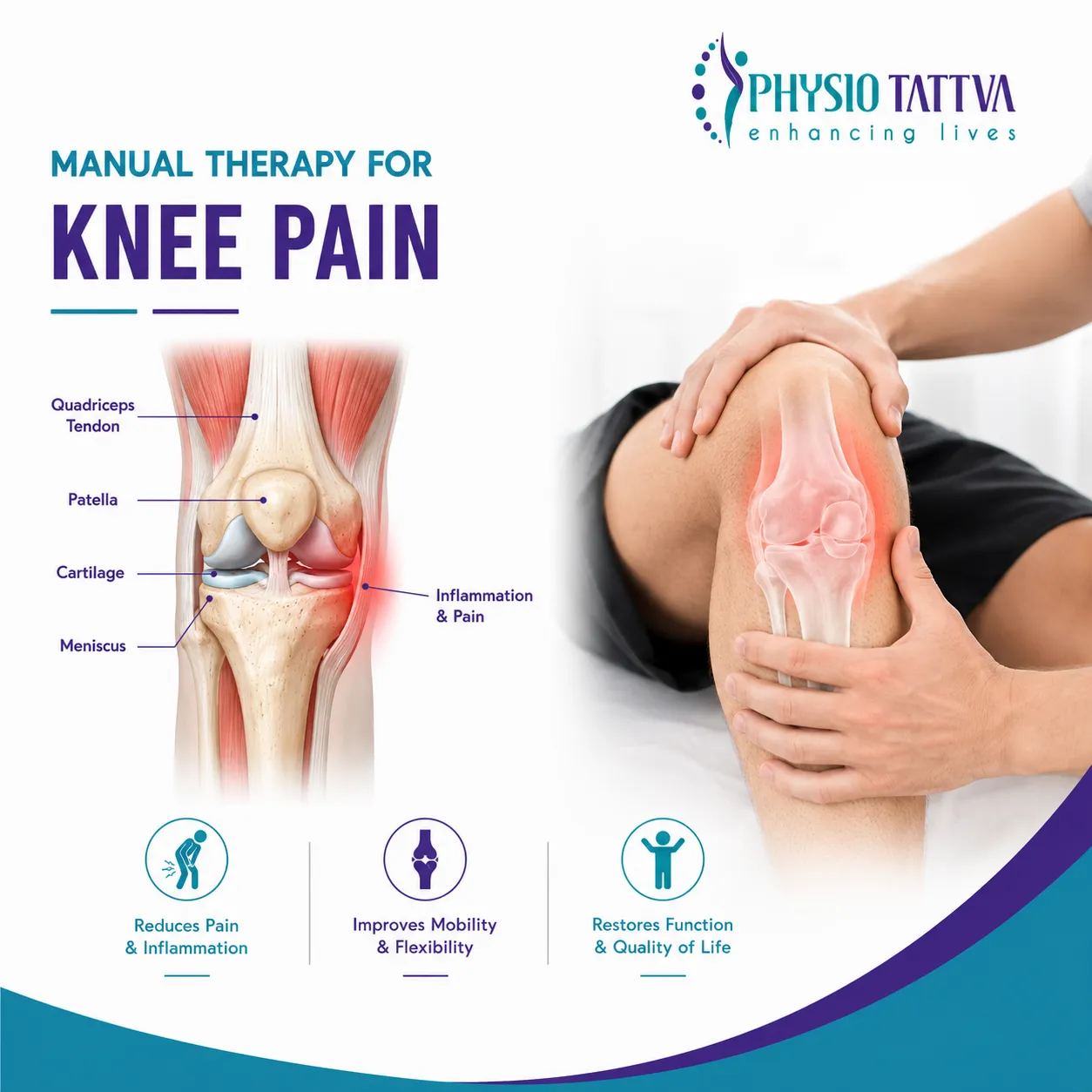
Common Knee Conditions Treated with Manual Therapy
Manual therapy is not a one-size-fits-all solution. It is highly effective when tailored to specific knee conditions, including:
- Patellofemoral Pain Syndrome (Runner's Knee): This common condition involves pain around the kneecap (patella). Manual therapy can help by mobilizing the patella to improve its tracking and releasing tight surrounding structures like the IT band and quadriceps.
- Knee Osteoarthritis (OA): For those with "wear and tear" arthritis, gentle joint mobilizations can help lubricate the joint, reduce stiffness, and decrease pain, making exercise more tolerable.
- IT Band Syndrome: Manual therapy, specifically soft tissue mobilization and myofascial release, is excellent for releasing the tension in the iliotibial (IT) band and the associated hip muscles (TFL, glutes) that cause pain on the outside of the knee.
- Post-Surgical Rehabilitation: After procedures like an ACL reconstruction or knee replacement, manual therapy is crucial for breaking down scar tissue, reducing swelling, and restoring normal joint movement (arthrokinematics).
- Ligament Sprains (MCL, LCL): Once the acute phase has passed, manual techniques can help manage swelling and gently reintroduce movement to prevent excessive stiffness.
- Meniscus Injuries (Conservative Care): For non-operative meniscal tears, manual therapy can help unload the affected part of the joint and improve overall mechanics to reduce stress on the meniscus.
Key Manual Therapy Techniques for the Knee
A therapist will use a combination of techniques based on your specific diagnosis.
1. Soft Tissue Mobilization & Massage
This involves applying targeted pressure to muscles, tendons, and fascia.
- What it does: Breaks down scar tissue adhesions, releases muscle knots (trigger points), and improves blood flow.
- Techniques include: Manual therapy for knee pain uses several targeted hands-on methods designed to reduce tension, improve tissue mobility, and restore healthy movement patterns.
- Myofascial Release: Applying sustained pressure to release tightness in the connective tissue (fascia) around the quadriceps, hamstrings, and calves.
- Trigger Point Therapy: Applying direct pressure to painful knots in a muscle to release tension.
- Instrument Assisted Soft Tissue Mobilization (IASTM): Using specialized tools (like Graston™) to more effectively detect and treat fascial restrictions.
2. Joint Mobilization
This technique focuses on the joints of the knee complex (tibiofemoral, patellofemoral) and even adjacent joints like the hip and ankle.
- What it does: Restores the small, involuntary "gliding" and "sliding" motions within a joint capsule, which are essential for full, pain-free movement.
- How it's done: The therapist applies slow, gentle, and repetitive oscillatory movements to the joint in specific directions to reduce stiffness and pain. This is not the same as a high-velocity chiropractic adjustment.
3. Muscle Energy Techniques (MET)
MET uses a patient's own muscle contractions to relax and lengthen a muscle or realign a joint.
- How it's done: You will be asked to gently push against the therapist's hand for a few seconds, then relax, allowing the therapist to guide the limb into a new, greater range of motion. It's an active technique that is very safe and effective.
4. Passive Stretching
The therapist will gently move your knee and leg into a stretched position to improve flexibility in tight muscles like the hamstrings, quadriceps, and calf muscles, all of which heavily influence knee mechanics.
Important: Manual Therapy is Part of a Complete Plan
While highly effective, manual therapy works best when combined with a comprehensive treatment plan. A typical session will integrate hands-on work with:
- Therapeutic Exercise: You will be prescribed specific strengthening and stretching exercises to correct imbalances and support the improvements gained during manual therapy. Strong muscles protect the joint.
- Patient Education: Understanding your condition, learning how to modify activities, and proper body mechanics are crucial for long-term success.
- Neuromuscular Re-education: Retraining your muscles and nerves to work together for better stability, balance, and coordination.
Who Can Perform Manual Therapy for Knee Pain?
To ensure safety and effectiveness, seek treatment from a licensed professional with advanced training in orthopedic manual therapy, such as:
- Physical Therapists (PT, DPT): Especially those with fellowship training (FAAOMPT) or board certification (OCS).
- Chiropractors (DC): Many have specialized training in extremity adjusting and soft tissue work.
- Osteopathic Physicians (DO): Trained in osteopathic manipulative treatment (OMT).
- Sports Physiotherapists: Experienced in athletic knee injuries, movement analysis, and performance rehabilitation.
Avoid receiving manual therapy from untrained providers, as improper techniques may worsen symptoms. Seek a specialist if knee pain persists, limits your mobility, or interferes with daily activities.
Experience Lasting Knee Relief Through Expert Care at Physiotattva
If you're searching for a long-term solution rather than temporary relief, manual therapy for knee pain offers a powerful, personalised approach. This hands-on treatment helps identify the mechanical imbalances, muscle tightness, and joint restrictions that often go unnoticed but contribute to chronic discomfort. By improving mobility, reducing inflammation, and restoring proper movement patterns, manual therapy supports your body’s natural healing process. A skilled physical therapist can tailor each technique, mobilisation, soft tissue release, or stretching, to your specific condition. When paired with strengthening exercises and functional training, it helps you return to daily activities with more ease and confidence. Manual therapy is more than symptom relief; it’s a pathway to stronger, healthier, and more resilient knees.
At Physiotattva physiotherapy clinics in Bangalore and Hyderabad, you receive personalised care tailored to your specific needs, ensuring effective results and comfort throughout your journey to recovery.
Don’t wait to start your recovery! Get in touch with Physiotattva for more details! Contact us at +91 89510 47001.
Why Physiotattva?
22+
50,000+
95%
200+
25+
4.8
Cities We Serve

Bangalore
At Physio Tattva, we are committed to bring access to quality physio care through ultra-modern clinics and high-skilled practitioners to all.
.webp)
Hyderabad
At Physio Tattva, we are committed to bring access to quality physio care through ultra-modern clinics and high-skilled practitioners to all.
.webp)
Vishakhapatnam
At Physio Tattva, we are committed to bring access to quality physio care through ultra-modern clinics and high-skilled practitioners to all.
Core Treatments
Core Conditions
Core Symptoms
Frequently Asked Questions
What exactly is manual therapy for knee pain?

What specific knee conditions can manual therapy help with?
Is manual therapy for the knee painful?
What techniques are involved in manual therapy for the knee pain?
How is manual therapy different from a regular knee massage?



%20(1)-p-3200.jpeg)


.jpg)
.webp)
.webp)
.webp)