




When people talk about "cracking joints" in a therapeutic context, they are usually referring to a specific type of manual therapy that produces an audible "pop" or "crack." This sound is often associated with relief from stiffness, discomfort, and restricted movement.
This article breaks down what this therapy is, why the cracking sound occurs, its potential benefits, the risks involved, and the trained professionals who perform it, helping you understand whether this approach may be right for your condition.
What Is Manual Therapy for "Cracking Joints"?
The clinical term for the "cracking" technique is joint manipulation or a High-Velocity, Low-Amplitude (HVLA) thrust. It is a skilled, hands-on method used by trained healthcare professionals to restore proper movement to a joint that has become stiff, restricted, or dysfunctional. This technique requires precision, anatomical knowledge, and controlled force to ensure both safety and effectiveness.
The primary goal is not to simply create a sound. Instead, the intention is to improve the joint’s range of motion, reduce pain, calm surrounding muscle tension, and restore normal movement patterns. The audible pop, while common; is merely a byproduct of the technique and not an indicator of treatment success. Some highly effective manipulations occur without any sound at all.
The Science Behind the "Crack": What is Joint Cavitation?
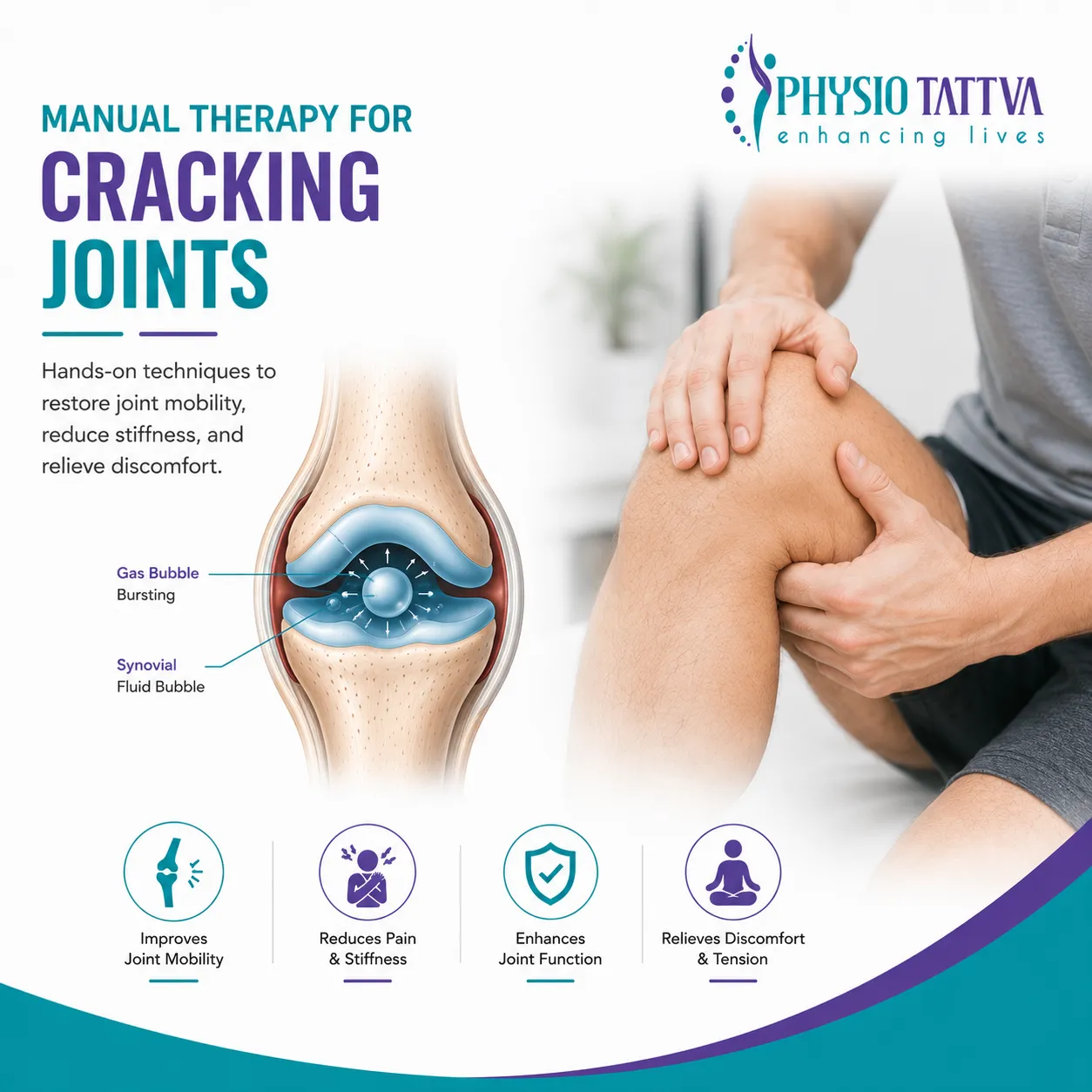
The popping sound, known as joint cavitation, is not caused by bones rubbing together. It is a result of a pressure change within the joint capsule.
- Synovial Fluid: Your joints are lubricated by a thick liquid called synovial fluid, which contains dissolved gases (like nitrogen and carbon dioxide).
- Pressure Drop: When a therapist performs a quick, gentle thrust on a joint, the joint surfaces are slightly separated. This rapid increase in volume causes a sharp drop in pressure within the joint capsule.
- Gas Bubble Formation: The pressure drop allows the dissolved gases to rapidly come out of solution and form a bubble.
- The "Pop": The audible "crack" is the sound of this gas bubble forming.
After cavitation, it takes about 20-30 minutes for the gases to re-dissolve into the synovial fluid, which is why you can't immediately "re-crack" the same joint.
Who Performs Manual Therapy for Cracking Joints?
Several licensed healthcare professionals are trained in joint manipulation techniques:
- Chiropractors: This is a core technique in chiropractic care, often referred to as a "chiropractic adjustment" or "spinal manipulation therapy." Chiropractors use it to correct joint misalignments (subluxations) and improve nervous system function.
- Physical Therapists (Physiotherapists): Many physical therapists are trained in spinal and peripheral joint manipulation (often called Grade V mobilization). They integrate it into a broader treatment plan that includes exercise, soft tissue work, and education.
- Osteopathic Physicians (DOs): Doctors of Osteopathy use a variety of hands-on techniques called Osteopathic Manipulative Treatment (OMT). HVLA thrusts are one of the many tools they use to improve the body's structure and function.
Benefits of Joint Manipulation
When performed correctly for the right candidate, joint manipulation can provide several important benefits:
- Increased Range of Motion: Immediately improves a joint's ability to move freely.
- Pain Relief: The quick stretch of the joint capsule can trigger nerve reflexes that block pain signals and relax surrounding muscles.
- Reduced Stiffness: Helps break up minor adhesions and tension that limit normal movement.
- Improved Function: Restoring mobility and reducing pain allows for smoother, more efficient movement during daily activities.
- Enhanced Muscle Activation: Manipulation can "reset" muscle firing patterns, helping weak or inhibited muscles engage properly.
- Better Joint Alignment: Helps the joint return to a more optimal position, reducing compensatory strain on nearby structures.
- Sense of Relief and Ease: Many people experience an immediate feeling of lightness, reduced pressure, or improved comfort after treatment.
Is Manual Therapy for Cracking Joints Safe?
For most people, joint manipulation is very safe when performed by a trained and licensed professional. However, like any hands-on treatment, it’s important to understand both the benefits and the limitations. Below is a clear breakdown of the risks, precautions, and situations where this therapy may not be suitable.
Potential Risks of Manual Therapy (Generally mild and temporary)
Although manual therapy is considered safe when performed by a trained professional, it’s important to be aware of the possible effects that may occur after treatment:
- Localized soreness or stiffness for 24-48 hours.
- Minor muscle strain.
- Headache (common after neck manipulation).
Serious Risks (Very Rare): The most discussed serious risk is associated with neck (cervical spine) manipulation. There is a very rare risk of causing a tear in an artery in the neck (vertebral artery dissection), which can lead to a stroke. While statistically extremely low, practitioners are trained to screen for risk factors.
Who Should AVOID Manual Therapy (Contraindications)?
While joint manipulation is safe for many people, certain conditions make this treatment unsuitable. Avoid or delay manipulation if you fall into any of the following categories:
- Individuals with severe osteoporosis.
- People with known spinal instability or fractures.
- Those with spinal cancer or certain bone diseases.
- Patients with advanced inflammatory arthritis (e.g., Rheumatoid Arthritis, Ankylosing Spondylitis) during a flare-up.
- Individuals on blood-thinning medication or with blood-clotting disorders.
- Patients with certain vascular conditions.
A thorough medical history and physical examination are essential before any manipulation is performed.
Cracking Joints on Your Own vs. Professional Manipulation
Forcibly cracking your own neck or back is not the same as receiving a professional adjustment. While you might achieve a similar popping sound, you lack the training to apply a specific, controlled force to the correct joint in the right direction. This can lead to hypermobility (too much movement) in some segments, while the truly "stuck" joint remains stiff.
What About Joints That Crack Naturally? (Crepitus)
General joint popping and clicking during normal movement is called crepitus. This is different from therapeutic manipulation. Crepitus is often caused by:
- Tendon or ligament snapping over a bony structure.
- Gas bubbles forming and collapsing naturally (as described above).
- Rough joint surfaces (common in arthritis).
The general rule: If the cracking or popping is not accompanied by pain, swelling, or a feeling of the joint locking, it is usually harmless and requires no treatment. If it is painful, see a doctor or physical therapist.
When to See a Professional for Cracking Joints
Consider seeking manual therapy from a qualified professional if you experience:
- Persistent joint stiffness that limits your movement.
- A feeling of a joint being "stuck" or "out of place."
- Pain in your back, neck, or other joints that isn't resolving.
- Headaches that may be originating from neck stiffness.
- Reduced mobility following a minor injury (once serious injury is ruled out).
Improve Joint Movement with Physiotattva
If cracking joints leave you unsure whether it’s harmless or a sign of something deeper, manual therapy can offer clarity—along with real relief. This approach focuses on restoring proper joint mechanics, easing stiffness, and improving overall mobility rather than just creating a popping sound.
Our skilled physiotherapists evaluate your movement, identify restricted joints, and use precise, evidence-based techniques to help you feel better and safer. With personalised care, guided exercises, and expert monitoring, you can move with greater confidence and comfort. Whether you’re managing pain, stiffness, or recurring cracking, Physiotattva helps you take the next step toward healthier, smoother movement.
At Physiotattva physiotherapy clinics in Bangalore and Hyderabad, you receive personalised care tailored to your specific needs, ensuring effective results and comfort throughout your journey to recovery.
Don’t wait to start your recovery! Get in touch with Physiotattva for more details! Contact us at +91 89510 47001.
Why Physiotattva?
22+
50,000+
95%
200+
25+
4.8
Cities We Serve

Bangalore
At Physio Tattva, we are committed to bring access to quality physio care through ultra-modern clinics and high-skilled practitioners to all.
.webp)
Hyderabad
At Physio Tattva, we are committed to bring access to quality physio care through ultra-modern clinics and high-skilled practitioners to all.
.webp)
Vishakhapatnam
At Physio Tattva, we are committed to bring access to quality physio care through ultra-modern clinics and high-skilled practitioners to all.
Core Treatments
Core Conditions
Core Symptoms
Frequently Asked Questions
What is manual therapy for cracking joints?

Why do my joints crack and pop in the first place?
Is it safe to have my joints "cracked" with manual therapy?
What's the difference between joint cracking from manual therapy and the cracking I do myself?
When should I see a professional for my cracking joints?






%20(1)-p-3200.jpeg)


.jpg)
.webp)
.webp)
.webp)