




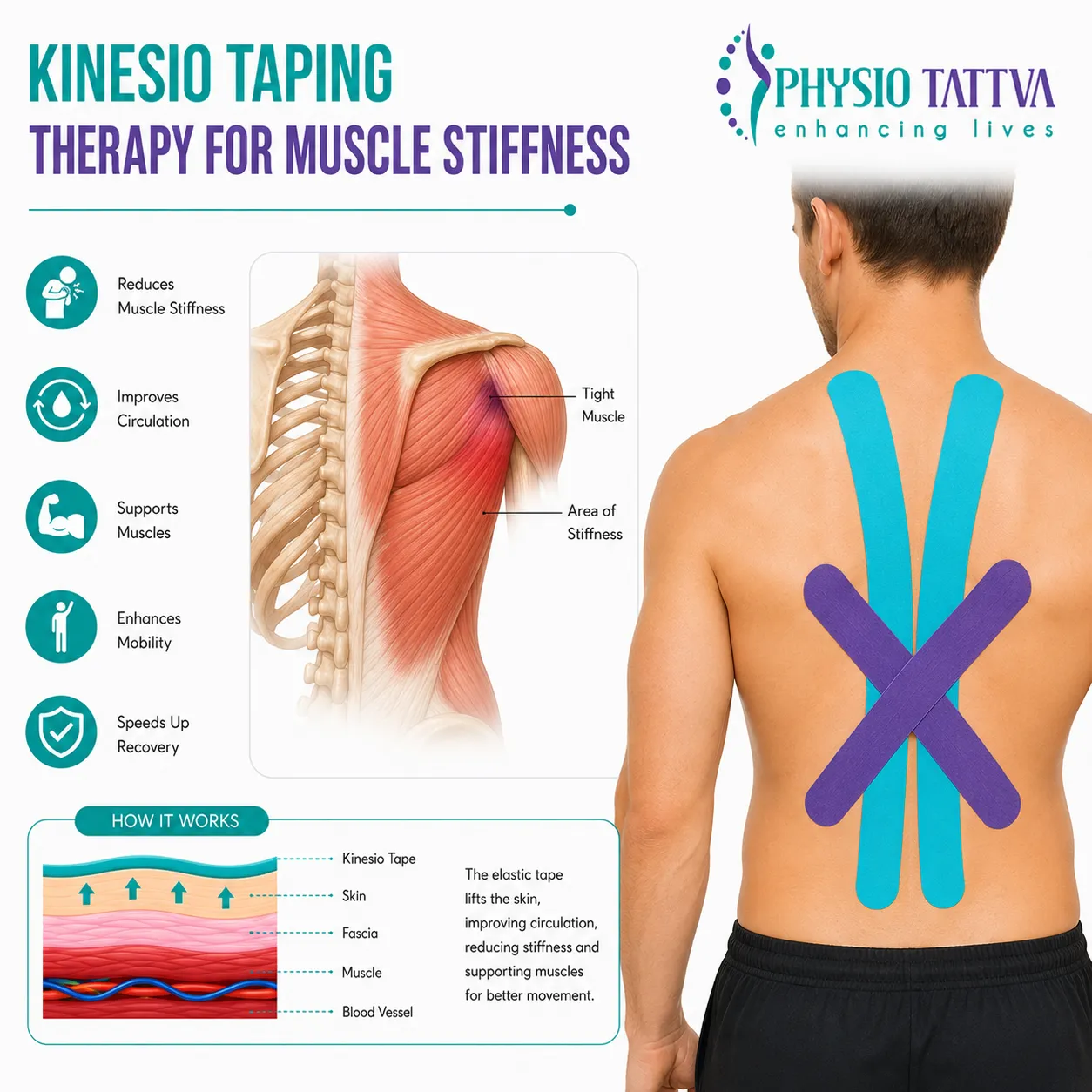
Kinesio taping therapy for muscle stiffness is an increasingly popular method for relieving tight, sore muscles without restricting activity. The tape’s elastic structure lifts the skin slightly, helping reduce pressure, improve circulation, and ease discomfort. This creates a supportive environment that helps stiff muscles relax and recover more efficiently. Many people find it helpful for managing tension from long hours at a desk, exercise fatigue, or repetitive strain. Used alongside stretching, strengthening, and corrective exercises, Kinesio taping becomes a powerful tool for improving mobility and supporting long‑term muscle health.
What is Kinesio Taping?
Kinesio Taping (also known as Kinesiology Tape or KT Tape) is a therapeutic technique that uses a specialized, flexible, and elastic tape to support muscles and joints, reduce pain and swelling, and improve function. Unlike rigid athletic tape, which immobilizes a joint, Kinesio tape is designed to mimic the elasticity of human skin, allowing for a full range of motion while providing functional support.
Understanding Muscle Stiffness
Muscle stiffness is the sensation of tightness, soreness, and reduced flexibility in a muscle. It often occurs after:
- Overexertion: Especially from new or intense exercise (causing Delayed Onset Muscle Soreness or DOMS).
- Muscle Guarding: Involuntary tensing of muscles around an injured or painful area.
- Poor Posture: Chronic tension from holding the body in an unnatural position.
- Inactivity: Muscles can become stiff after long periods of being sedentary.
Physiologically, stiffness can be linked to microscopic muscle damage, inflammation, reduced blood flow, and the buildup of metabolic byproducts.
How Kinesio Taping Therapy Helps with Muscle Stiffness (The Mechanisms)
Kinesio tape is theorized to alleviate muscle stiffness through several key mechanisms. When applied correctly to a stiff or overactive muscle, it primarily works to inhibit or "calm down" the muscle.
Mechanism 1: Decompression and Increased Space
This is the most widely cited theory. When Kinesio tape is applied with a slight stretch, its elastic properties gently lift the skin and the superficial fascia away from the underlying muscle.
- Effect: This creates a microscopic space, which reduces pressure on pain receptors (nociceptors) and allows for better fluid movement.
- Result for Stiffness: Relieves the sensation of pressure and tightness. It allows for improved circulation of blood and lymphatic fluid, which helps flush out inflammatory substances (like lactate and cytokines) that contribute to soreness and stiffness.
Mechanism 2: Pain Modulation (Gate Control Theory)
The light, constant sensation of the tape on the skin sends new sensory signals to the brain.
- Effect: These non-painful signals travel along larger nerve fibers that are faster than pain signals. According to the Gate Control Theory of Pain, this new sensory input can effectively "close the gate" on the pain signals coming from the stiff muscle.
- Result for Stiffness: The brain perceives less pain and stiffness, allowing the muscle to relax and move more freely.
Mechanism 3: Neuromuscular Inhibition and Proprioception
The tape provides continuous tactile feedback to your nervous system, making you more aware of your muscles’ position and state (proprioception).
- Effect: For a stiff, overused muscle, the tape is applied in a way that signals the nervous system to reduce its firing rate. This is known as inhibition. It discourages the muscle from remaining in a state of constant, low-level contraction.
- Result for Stiffness: The muscle "learns" to relax, breaking the cycle of muscle guarding and chronic tightness.
How to Apply Kinesio Tape for Muscle Stiffness (Inhibition Technique)
The application technique is crucial for achieving the desired effect. To reduce stiffness and relax an overactive muscle, the inhibition technique is used.
- Direction: The tape is applied from the muscle's insertion point toward its origin point (or distal to proximal). For example, to relax a stiff bicep, you would tape from just below the elbow crease up toward the shoulder.
- Stretch: The muscle should be placed in a stretched position during application, but the tape itself should be applied with a very light stretch (0-25%). The goal is not to pull or restrict, but to gently lift and provide sensory input.
- Anchors: The first and last inch of the tape (the "anchors") are always applied with no stretch to prevent skin irritation.
- Cut Style: For general stiffness along a muscle belly, a simple "I" strip is common. For areas of localized swelling or intense stiffness (like a "knot"), a "Fan Cut" or "Web Cut" can be used to maximize decompression over a wider area.
Example Application: Kinesio Taping for a Stiff Upper Trapezius
To help you understand how the inhibition technique works in practice, here’s a step-by-step application for one of the most common areas of muscle stiffness, the upper trapezius (neck/shoulder region):
- Position: Sit and tilt your head away from the stiff shoulder, looking down toward your opposite armpit. This stretches the upper trapezius muscle.
- Anchor: Apply the first anchor of the tape with no stretch on the top of the shoulder (the acromion process).
- Application: Gently lay the tape with 15-25% stretch up along the muscle toward the base of your skull.
- End Anchor: Apply the last inch of the tape behind your ear/at the base of the skull with no stretch.
- Activation: Rub the tape firmly to activate the heat-sensitive adhesive.
Is It Effective? The Evidence and Practical Verdict
The scientific evidence for Kinesio taping is mixed but generally points toward short-term benefits, especially for pain and range of motion.
- What It Does Well: Many users and clinicians report immediate, noticeable relief from pain and stiffness. It is an excellent tool for providing comfort and facilitating movement.
- The Placebo Effect: The sensation of being treated and the physical feeling of the tape can have a powerful placebo effect, which is a real and valid component of pain relief.
- The Verdict: Kinesio tape is not a standalone cure. Its greatest strength is as an adjunctive therapy. It works best when used to bridge the gap between injury/stiffness and active recovery. By reducing pain and stiffness, it allows a person to perform the therapeutic exercises and stretches that are essential for long-term recovery.
Benefits & Considerations
Kinesio taping can be highly effective when applied properly, but it isn’t suitable for every situation. The following sections break down the key advantages you can expect, along with crucial considerations to ensure safe, appropriate use, especially if you're dealing with ongoing stiffness or underlying conditions.
Key Benefits
Kinesio taping offers several meaningful advantages when used correctly for muscle stiffness. Below are the primary benefits individuals commonly experience:
- Drug-Free Pain Relief: Offers a non-pharmacological way to manage discomfort.
- Supports Active Recovery: Unlike a brace, it allows and encourages movement.
- Improves Body Awareness: The proprioceptive feedback can help you correct poor posture that contributes to stiffness.
- Can Be Worn for Days: The tape is water-resistant and can be worn for 3-5 days, providing continuous therapeutic input.
Important Considerations
Before using Kinesio tape, it’s essential to understand key precautions to ensure safe and effective application. Keep the following points in mind:
- Get a Proper Diagnosis: Do not use tape to cover up a serious injury. See a healthcare professional to understand the root cause of your stiffness.
- Professional Application is Key: For best results, have the tape applied by a physical therapist, chiropractor, or athletic trainer who is trained in the correct techniques.
- Skin Sensitivity: Do not apply over open wounds, active infections, or fragile skin. Test a small patch if you have sensitive skin, as allergic reactions to the adhesive can occur.
- Serious Conditions: Avoid use over areas with deep vein thrombosis (DVT), cancer/tumors, or active cellulitis.
Experience Relief with Kinesio Taping Therapy at Physiotattva
Kinesio taping therapy for muscle stiffness offers a gentle, non-invasive solution to reduce soreness, improve flexibility, and support healing. By lifting the skin and improving circulation, it helps relax overworked muscles and enhances mobility. Whether you're recovering from overuse, poor posture, or daily tension, Kinesio taping can be a valuable part of your wellness routine. While not a standalone cure, it pairs perfectly with stretching, strengthening, and postural correction for lasting results. Always consult a professional for proper assessment and taping technique.
At Physiotattva physiotherapy clinics in Bangalore and Hyderabad, you receive personalised care tailored to your specific needs, ensuring effective results and comfort throughout your journey to recovery.
Don’t wait to start your recovery! Get in touch with Physiotattva for more details! Contact us at +91 89510 47001.
Why Physiotattva?
22+
50,000+
95%
200+
25+
4.8
Cities We Serve

Bangalore
At Physio Tattva, we are committed to bring access to quality physio care through ultra-modern clinics and high-skilled practitioners to all.
.webp)
Hyderabad
At Physio Tattva, we are committed to bring access to quality physio care through ultra-modern clinics and high-skilled practitioners to all.
.webp)
Vishakhapatnam
At Physio Tattva, we are committed to bring access to quality physio care through ultra-modern clinics and high-skilled practitioners to all.
Core Treatments
Core Conditions
Core Symptoms
Frequently Asked Questions
How does Kinesio taping help with muscle stiffness?

Is Kinesio taping effective for all types of muscle stiffness?
Can I apply Kinesio tape myself for muscle stiffness?
How long should I leave Kinesio tape on for stiff muscles?
Is Kinesio taping a permanent fix for muscle stiffness?






%20(1)-p-3200.jpeg)


.jpg)
.webp)
.webp)
.webp)